Can government legislate "intellectual diversity" (without becoming the "thought police")?
 A breath of fresh air – or the first step down a slippery slope?
 “Academic freedom” has been a growing buzzword in recent years for conservatives paying attention to the goings-on at America’s college campuses. The leftist tendencies inherent in academia are, of course, not a new development, though they have been better-documented of late by conservative writers, such as UNC-Wilmington professor Mike Adams, and activists, like David Horowitz.
Case after case of liberal activism and indoctrination has been publicized by conservative individuals, and by organizations like the Foundation for Individual Rights in Education (FIRE) and the Alliance Defense Fund (ADF). As a result, acts which in the past might have gone unnoticed and unquestioned – such as a Northern Kentucky professor’s demolishing of an anti-abortion display, or the University of Georgia’s disqualification of a Christian fraternity from student-organization privileges due to its requirement that its members be Christian – have been both exposed and corrected through quick, vigilant action on the part of those who were willing to stand up for actual equal treatment of college students, regardless of political affiliation or religious beliefs.
However, despite the watchfulness of those on the outside, America’s universities maintain their seemingly irreversible liberal bent. Part of this is because of a natural imbalance in the ideology of those employed there; another part is that one rarely seems able to find a professor they can peg as "conservative," due to the fact that those who lean right - bless their souls - do their job correctly, and rarely reveal their personal political inclinations in the classroom.
Campus conservatives have long worked responsibly and within legal boundaries to express their views and to fight for a more open academic environment. Some conservative activists, though, have made a pastime of purposely bending and breaking rules for the “greater good” of exposing perceived liberal bias in the enforcement of those rules. Unfortunately, the actions of the latter have had the doubly regrettable result not only of reflecting poorly on the majority who fit the former profile, but also of quite possibly setting back the movement for conservative equality on campus by a significant margin due to their brash, distasteful tactics which serve both to align the administration against them and to dissuade their fellow campus conservatives from speaking out when they in turn are wronged unjustly, lest they be painted with the same brush.
The current intellectual state of our college campuses is clear. So, what is it that needs to be done? Can conservative students still survive in academia? Or has the liberal bias on campus – in the form of speech codes, student conduct guidelines, and professorial indoctrination – gotten so out of hand that government needs to intervene?
There have been recent moves to involve the State in issues of academia, but they have largely taken place in the courts. The threat of a lawsuit was the impetus in overcoming the University of Georgia’s aforementioned opposition to the registration of a Christian fraternity; likewise, two students at Georgia Tech scored a dubious success last year when the suit they filed against their Institute resulted in the scrapping of campus speech codes – a victory, due the imbalance in plaintiff expectation and reality, which was as ironic as it was dubious, as their success directly resulted in the abuse the plaintiffs received during their legal crusade being made wholly and permanently permissible.
Now, in Georgia, the legislative branch appears poised to get in on the act, as well. The sponsors of controversial House Bill (HB) 154 (or the “Intellectual Diversity in Higher Education Act”), is currently working its way through the state’s General Assembly, ostensibly hope to help shield students from unwelcome political indoctrination in the classroom, to help remove the yoke of political correctness from inter-student discourse and expression, and to help prevent teachers from being denied tenure (or worse, fired) because of their political leanings – in other words, they hope to help break the liberal grip on academia.
On the surface, these seem like admirable enough goals. What measures, though, would actually be put into place should HB 154 pass – and would the passage of this legislation serve as an end in itself, or would it only encourage government to further legislate the thoughts and actions of those on this nation’s college campuses? For, regardless of whether or not this bill would actually provide a temporary respite for conservatives students and faculty who have long had to struggle to get by in an environment which is predisposed toward modern liberalism, there is the worrisome prospect that HB 154 is simply the first step in a process to legislate the actions and, more importantly, the thoughts of those who inhabit America’s “marketplaces of ideas.”
In all fairness, the Intellectual Diversity in Higher Education Act does not regulate either thought or action on the part of students or faculty in Georgia’s colleges. What it does do is two things. First, it proposes a definition of the term “intellectual diversity” (the “foundation of a learning environment that exposes students to a variety of political, ideological, and other perspectives”), and suggests ways of demonstrating a commitment to that diversity. These suggestions range from “conducting a study to assess the current state of intellectual diversity on…campus,” to “including intellectual diversity issues in student course evaluations,” to “creating an institutional ombudsman on intellectual diversity.” The bill contains twelve such suggestions in all. Second, HB 154 directs the state’s Board of Regents to “require each institution under its control to report annually to the [Georgia] General Assembly, detailing the steps that the institution is taking to ensure intellectual diversity and the free exchange of ideas.”
This is the only legal directive in this bill – the requirement for annual submission of a report to the state legislature on the steps being taken to ensure intellectual diversity on campus and in the classroom. However, it is not this bill, per se, that should worry conservatives, as the ideals sought by this legislation are positive. Rather, it is the potential for further legislation which is a cause for concern - legislation which could result in further legal regulation of ideology and expression.
Speech codes, political correctness, glorification of superficial racial diversity, and uneven enforcement of regulations have all contributed to the destruction of the image (as utopian as it may have been) of the American university as a place where young people can be exposed to truly diverse ideas and viewpoints. However, within the attempt to correct this situation through legislation lies the potential for the scales not only to be balanced, but to be tipped in the opposite direction – or in any direction future lawmakers (and judges) may decide. The legislation of thought, whether it be the regulation of speech or the enforcement of the availability of diverse of viewpoints, leads down the same slippery slope, regardless of intent – and, for the rational conservative, the final destination is not a desirable one, regardless of the “greater good” which may have been served in getting there.
Jeff Emanuel, a Special Operations military veteran, is a Leadership fellow with the Center for International Trade and Security at the University of Georgia, where he also studies Classics. In addition, he is a contributing editor for conservative web log Red State, and is a columnist for the Athens, GA Banner-Herald newspaper.
Labels: Academia, Republicans
Permalink |
|


 Cagle's victory in Republican primary reflects story of his life
 |
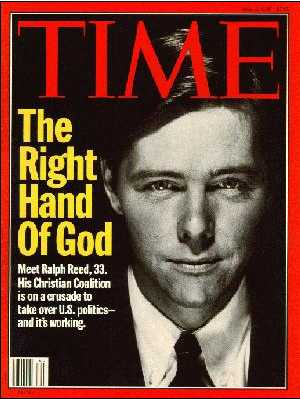
The statewide race that drew national attention ended with a whimper Tuesday night. When it was all said and done, the negatives against the man Time magazine once anointed "The Right Hand of God" proved too great to win the support of the majority of Georgia's Republicans.
Ralph Reed entered the race for lieutenant governor in early 2005 as a runaway favorite to win, with off-the-charts name recognition and a slate of nationally prominent supporters. In the end, though, the former Christian Coalition executive director, Georgia GOP chairman and political operative, who boasted "the most effective, grass-roots, get-out-the-vote effort that this state (had) ever seen in a down-ballot campaign," proved unable to defeat a little-known state senator for his party's nomination.
Ninth-generation Georgian Casey Cagle defeated his Miami-raised opponent - who was running for elective office for the first time amid rampant speculation he was seeking the office only as a steppingstone to the governorship - both by communicating his positive vision for Georgia, and by convincing voters Reed's values were "for sale to the highest bidder."
Cagle's victory is being viewed by many as a triumph of traditional Southern values over corporate, for-profit religiosity, and it unquestionably showed that, regardless of political credentials, character does matter to Georgia's voters. The dark cloud of Reed's association with former lobbyist Jack Abramoff and all the negatives it entailed, from the Indian gaming and money-laundering scandal, to lobbying against regulation of the inhuman working conditions in the Marianas Islands, to, finally, a lawsuit filed a week before the election alleging the pair defrauded a Texas Indian tribe, added up to more than even the smooth-talking icon of the pseudo-Religious Right could weather.
The Republican ticket for November's general election will be stronger with Cagle as the nominee for lieutenant governor. Cagle's 12 years of legislative experience and knowledge of policy issues will benefit him this fall. Should he be elected, he'll be able immediately to work with the Republican majority.
Twenty-one GOP state senators not only endorsed Cagle in the primary, but signed a letter to Reed asking him to drop out of the race for the good of the state and party. This casts doubt on whether Reed would have had any impact on the Senate from the already weak position of lieutenant governor, or whether legislators would have worked to further weaken him and his position, if he had gone on to win the general election.
Beyond his legislative experience and mainstream electoral viability, Cagle improves the GOP's chances this fall - and takes away Democrats' best weapon - simply by not being Ralph Reed. If there was any question which candidate Democrats were prepared to mobilize against this fall, it was answered at the July 9 Atlanta Press Club debate, where Democratic candidates for lieutenant governor spoke repeatedly, not of the need not to defeat the GOP, but to defeat Ralph Reed. Polls repeatedly showed Reed as a drag on the Republican ticket in the general election, a concern for what is still expected to be a tight gubernatorial race. With Cagle as the nominee, that's no longer a factor.
With Cagle, Georgia Republicans have a nominee who can potentially reunite a party bitterly divided by the last year's campaigning. An online poll, hosted by Georgia political Web log Peach Pundit, asked readers whether they would support the lieutenant governor nominee. A whopping 50.8 percent of respondents said they were Cagle supporters, and wouldn't vote for Reed in the general election. In contrast, only 11.5 percent said they were Reed supporters, and wouldn't support Cagle. This polling demonstrated the divisiveness Reed brought to the state and the GOP by running for office while he was a figure in a Washington scandal.
Cagle's against-all-odds victory was a parallel of his life story to this point. He was raised by a single mother, who often worked multiple jobs to provide for her family, but "never took a dime of government assistance." A public school product who never graduated from college, Cagle rose from unskilled laborer to successful self-made business owner. It was that life experience, combined with a desire to do good for Georgia, which propelled Cagle from being such an afterthought in this race that he was one of five attendees at his own candidate tailgate here in Athens last football season - while crowds of people fawned over Reed at his site up the street - to being arguably the greatest political giant-killer in recent memory, if not in Georgia primary history.
• Jeff Emanuel, a Special Operations military veteran who served in Iraq, is a senior at the University of Georgia. He serves as public-relations director for the UGA College Republicans, the largest student political organization in the country. The opinions expressed in his column do not necessarily reflect the opinions of the UGA College Republicans.
Published in the Athens Banner-Herald on 072006
Labels: Elections, Primaries, Republicans
Permalink |
|

Frist and the marriage amendment
By Jeff Emanuel
Jun 8, 2006
 The timing of the Marriage Amendment's introduction to the nation by President Bush, and in the Senate by Majority Leader Frist, was vigorously attacked from several sides. Some said it was being used to take the public's eyes off of Iraq, gas prices, global warming, the 6/6/06 coming out of President Bush as the antichrist, and any conceivable combination of these and countless other ludicrous ideas. Leftist website Democrat Underground opined that the President brought up this amendment now for the misguided purpose of “pander[ing] do his bigoted, extremist base…that hates gays, women and Mexicans…when there are so many far more pressing issues to address.” Even notable individuals who often back the implementation of conservative thought and policy, such as rare pro-national-security libertarian and Atlanta-based talk show host Neal Boortz, not only criticized the timing of the issue, citing the need to address far more critical matters like tax reform, earmark reform, and the increasing size of government, but also decried the perceived intrusiveness and discrimination on the part of the federal government that the proposed legislation represents.
With all the furor surrounding both the timing and the content of this proposal and its recent introduction, there is a serious need for some history, respect, and—believe it or not—congratulations to be injected into the conversation.
In February, I was among the thousands of attendees at this year’s Conservative Political Action Conference (CPAC) in Washington, DC. The three-day conference featured several conservative and Republican (a distinction which, unfortunately, is not redundant) speakers, including Vice President Cheney, Ann Coulter, former Speaker of the House Newt Gingrich, RNC Chairman Ken Mehlman, and, interestingly, Senate Majority Leader Bill Frist—a man who is hardly known for being an uncompromising voice for American conservatism. As a former resident of Tennessee—specifically, Fort Campbell, Kentucky (which anybody familiar with the area will know straddles the border between the two states; thus, with a mailing address in Kentucky, one of my senators was in fact Bill Frist)—I had been a supporter of Frist when he first became Majority Leader; however, like many conservatives, I had become increasingly disillusioned with him as a congressional leader in the past few years.
From the stage at CPAC, Frist spoke on several issues, from the war on terror to illegal immigration. While the audience was respectful of the senator, and listened intently to what he had to say, we were also sure to temper our enthusiasm for his words; like many of the "moderate" Republicans who came there to speak, Frist was careful only to tout conservative issues and ideals, understandably preferring to avoid any more centrist stances and issues in his speech. Thus, when he said on that Friday evening in February that he had already set a date to introduce into the Senate a Constitutional amendment protecting marriage, I, like many around me, gave the statement a passing wink and a nod, and promptly returned to wondering when—or whether—Frist would ever begin to govern like the conservative he was carefully impersonating. I did, however, in a fit of desire for accountability, put the date—June 5, 2006—into my PDA, intending to check on the progress of this supposed legislation at that time.
Not long after the conference, I stopped thinking about Frist’s speech and his promise to introduce such legislation in the Senate. This habit of moving on to other issues so quickly is a failing which I and too many other conservatives have, and an unfortunate reason that moderate Republicans are rarely held accountable for their all-too-rarely kept conservative promises. In the months since then, the need to protect traditional marriage has been widely discussed, and progress has been made on the issue in some areas; in many cases, though, the movement for marriage protection has been fought tooth-and-nail. In my own state, Georgia, an amendment to our Constitution which would have protected marriage—which was approved by 74% of the voters in 2004—was thrown out on a technicality by an activist Superior Court judge. The case for a national amendment, though, passed out of mind almost completely for all too many of us.
I must admit that I had my own doubts about the timing of this Amendment’s introduction. After all, illegal immigration has become a hot-button issue, and the Senate has responded by proposing a thinly-veiled amnesty; the Global War on Terror is raging on, and the left is doing all it can to subvert America’s effort to spread liberty and secure our nation; the economy is roaring back from recession, but the President seems allergic to proclaiming such truth from the Bully Pulpit. Surely these and many other issues are far more pressing than stopping everything to propose a (needed) Constitutional Amendment on marriage. Surely the reason for this was a desperate attempt to resuscitate the President’s approval rating. Surely Senator Frist was going along with it in an attempt to reach out to America’s conservatives in preparation for a run at the White House in 2008.
While watching the follow-up to the president’s Rose Garden press conference and contemplating this and other issues—including why politicians couldn’t just address the issues they were elected to lead on, and why they couldn’t ever just say what they mean, and do what they say—my reverie was disturbed by a poignant chime from the scheduling alarm on my PDA. Thinking I had forgotten a deadline, a meeting, or some other imposition on my day, I considered ignoring it completely, but instead decided to give it a quick look. Amazingly, with timing which by chance was truer than I could possibly have planned it, the screen showed these words, input back in February of this year: Marriage Amendment to Senate Floor. It was not until then that I recalled the promise of months before, made by a Senate Majority Leader whom we all thought to be feigning concern for conservative issues—a promise which, it turned out in the end, had been kept.
The Marriage Amendment was defeated Wednesday in the Senate, falling 18 votes short of the 67 necessary for passage. Bearing that fact in mind, this becomes true: whether or not you agree with the idea of amending the United States Constitution—and, by default, the Constitution of each of the fifty states—to protect marriage as being between one man and one woman (or to deny the “right” of same-sex couples to marry, if you prefer to think of it that way) is irrelevant. Likewise, whether or not you may think that this is an intrusive, inopportune time for the introduction of such an amendment into the Senate for debate, what with the day-to-day issues of the War on Terror, illegal immigration, the need for tax reform, et cetera, is also irrelevant.
What is relevant, not only for this issue but for the peace of mind so desperately needed not just by conservative citizens, but by all citizens, is this: a politician, having made a promise to constituents, voters, and the public at large, followed through and kept that promise, in spite of changing sentiment or intervening circumstances. It may be a sad indictment of our government that a single instance of a politician keeping their word stands out so greatly, and thus becomes deserving of such recognition. However, these facts remain: Senator Bill Frist did, in fact, make a promise to America one Friday evening in February and, when the time came to keep his end of the bargain, he did just that. True, it is only one man; beyond that, it is only one issue. However, it is an instance of an American politician doing exactly what he said he would—and that, at the very least, is a start.
Jeff Emanuel, a Special Operations military veteran, studies Classics at the University of Georgia. He is also a contributing editor for conservative web log RedState.com, and is a columnist for the Athens, GA Banner-Herald newspaper.
Copyright © 2006 Townhall.com
Labels: Policy, Republicans
Permalink |
|
Isakson out front on border security, tax reform
By Jeff Emanuel
May 30, 2006
At a time when ever-increasing government spending, slow movement on tax reform, and arguments for an amnesty-first immigration policy have revealed the dearth of true conservatives in Washington, Georgia's junior Senator Johnny Isakson has been a pleasant surprise.
Thought by many to be too moderate to adequately represent the red state of Georgia, Isakson was faced with a very difficult battle in the 2004 Republican primary against conservative African-American businessman Herman Cain. However, since being elected to the Senate eighteen months ago, he has sought to lead from the front on a host of conservative issues. Two of the best examples of this are his work on immigration and on taxation.
On February 22, Isakson and Sen. Norm Coleman (R-MN) led a Congressional delegation to the U.S.-Mexico border. In San Diego, they toured a recently discovered tunnel stretching from Tijuana, Mexico, to a warehouse in southern California. At the time of its discovery earlier this year, the tunnel had two tons of marijuana in it, and its structure included water pumps, lighting, and an air ventilation system. Isakson also witnessed the Border Patrol's detection of a pickup truck with a false bed concealing 13 illegals attempting to enter the United States.
Following this eye-opening experience, Isakson introduced legislation in the Senate aimed at providing increased manpower, equipment and technology to secure the U.S. border and to curb the inflow of illegal immigrants. "I observed firsthand the fantastic progress we're making in securing our borders in San Diego and in Arizona," he said, "and the keys to this progress are the exact kinds of manpower and technology that I am calling for in this legislation for the entire 2,000 miles of our southern border."
He has repeatedly voiced concern and disappointment over the Senate's unwillingness to put border security first, and in April he penned an op-ed for the Columbus Ledger-Enquirer in which he stressed the need for proper border security before any further steps are taken on the immigration issue.
Isakson's response to the president's May 15 immigration address was to call for a more permanent solution than the placement of largely transient National Guard troops on the border. Citing his opinion that "the Senate is too focused on guest worker programs and not enough on border security," he introduced an amendment the next day which would have modified any immigration reform bill to require that the Department of Homeland Security certify that the border is secure before a guest worker program can be instituted.
The amendment, which he had introduced for the first time in March, was unfortunately defeated by a vote of 55-40. However, according to a representative for the senator, some House leaders are saying that Isakson’s "border security first" policy may be the best way to bridge the gap between the House and the Senate when the immigration reform bill goes to conference.
On the subject of taxes, Isakson has done a good job of being a conservative voice of reason. He is a staunch supporter of making President Bush’s tax cuts permanent, and is a vocal opponent of the capital gains tax, which he calls a "major barrier to economic growth." His 2005 voting record earned him the "Taxpayers’ Friend Award" from the National Taxpayers Union.
Isakson has frequently voiced his belief that "the time has come to pursue fundamental changes" to the tax system. A proponent of analyzing several propositions and implementing the best system for Americans, Isakson is a co-sponsor of the Fair Tax bill (introduced by his fellow Senator from Georgia, Saxby Chambliss) and the Flat Tax bill. He also introduced the Tax Code Termination Act, which would "repeal the U.S. tax code and create a commission charged with reporting to Congress plausible reform options." The commission's tasks would include "[reviewing] the current tax code" and "[considering] whether the income tax should be replaced with a flat tax or a national sales tax." It would also "identify the transition costs associated with any change to the present federal tax code," and would "be required to report on the potential impact of such recommendations on the U.S. economy and on the government's ability to collect revenue."
The Act would terminate the current tax code on December 31, 2008, because, in Isakson's words, "history has taught us that if we don't impose a deadline and terminate the tax code by a date certain, overhauling our inefficient system is nearly impossible."
Isakson has been a satisfyingly consistent voice for conservative values since arriving in the Senate eighteen months ago. Regardless of whether or not his proposals on immigration and taxation are eventually adopted by the rest of Congress, it is good to know that, in this time of Republicans moderating their stances on key issues, there may still be a core of conservatives in Washington who are willing to stick to their beliefs rather than to seek political expediency, and who are willing to lead from the front on subjects that matter to the people of their states, and of America.
Jeff Emanuel, a Special Operations military veteran, studies Classics at the University of Georgia. He is also a contributing editor for conservative web log RedState.com, and is a columnist for the Athens, GA Banner-Herald newspaper.
Copyright © 2006 Townhall.com
Labels: Georgia, Republicans
Permalink |
|
Taking on a political celebrity
By Jeff Emanuel
May 12, 2006
Editor's Note: This is the second of a two-part series previewing Georgia's Lieutenant Governor's race. Part I can be read here.
The most heated Republican primary in Georgia is in full swing this election year, pitting state Senator Casey Cagle against conservative celebrity Ralph Reed.
A "seventh-generation North Georgian," with the accent and down-home manner to prove it, Casey Cagle accurately portrays himself as a living embodiment of the American dream. At the age of three, Cagle's father left him and his brother to be raised by their mother, who often had to work multiple jobs to provide for them—but who "never took a dime of government assistance." A public high school graduate, Cagle went into business at a young age, buying his first company at the age of 20, and quickly building a sizable portfolio of real estate and banking operations.
Running for elective office for the first time at age 28, Cagle defeated an incumbent Democrat to become the first Republican state senator from Hall County in Georgia history, and he has served there for twelve years.
Cagle’s voting record shows a dedication to many conservative issues, and he highlights this (while stressing Reed’s lack of legislative experience) when he speaks of his past achievements and of his goals as Lt. Governor. He touts the last 3 years of Republican leadership in the legislature, expressing pride in having "accomplished things they accomplished," such as "[changing] the entire business income tax structure, [cutting] a billion dollars (he pronounces it "DAH-lehs") in state spending, and [returning] $2 billion to taxpayers."
He also touts the successful Land Conservation Act, which "provides more greenspace and an incentive to keep it" that way, the passage of tort reform, increased spending on high school completion counselors, and the state's AAA bond rating, maintaining that "conservative values are at the forefront in the legislature."
Cagle cites the need to "create more economic opportunities for Georgia," but always takes care to point out that "government does not create jobs, but does create the infrastructure for jobs and businesses to be successful." On the subject of education, he stresses the need to remove the "bureaucracy that ties the hands of every teacher and administrator in our schools, and to allow them to work for what’s best for each child." He has taken a hard line on illegal immigration and on law-enforcement, voting for Georgia’s landmark Security and Immigration Compliance Act, and repeating the favorite quote that "America is a nation of immigrants and we have always welcomed new citizens to our shores. However, there is a right way and wrong way to become an American, and we cannot as a state allow large numbers of individuals to flagrantly violate our laws."
He repeatedly vows also to "continue to protect Georgia family values," citing his "record of 12 years that holds true" to this claim, including receiving the "highest ratings from Georgia Right to Life (he co-sponsored the Pharmacist Protection Act and the Women’s Right to Know Bill, among others), the Christian Coalition," and other organizations.
At each stop on the campaign trail, Cagle takes great care to stress the differences between himself and Reed. Though never addressing his opponent by name, Cagle repeatedly states that "the position of Lieutenant Governor is too important to elect someone who needs on-the-job training," and points out that the Lt. Governor, who "presides over the Senate, has always been elected from within the legislature."
Another frequent refrain of Cagle’s is that his opponent "has been asked by 21 of the 34 Republican Senators to withdraw from the race," which he follows by emphasizing that the winner of this race will have to be able to lead this body and to build consensus, openly questioning whether Reed could possibly function in such a position with so little support from the legislature. He also alludes to Reed’s ethical questions, though he never specifically mentions Jack Abramoff, and contrasts that against his own demonstrated personal "honesty and integrity."
As with any candidate, Cagle has weaknesses (which Reed is quick to highlight), including missed votes in the Senate. Though an avowed supporter of property rights (he has called the Supreme Court’s Kelo decision "very unfortunate," and maintains that in order for land to be condemned, it must clearly be blighted), Cagle was absent from the Senate floor when the vote was taken on Senate Bill 86, which was passed as counter-legislation to a bill (which was later withdrawn) that would have allowed broad use of eminent domain for private development.
Other missed votes include bills allowing excused school absences for children whose parents were in the military and were being deployed or are on leave in the war on terrorism, and providing for increased security at county courthouses. Cagle, who was in Washington the day of those votes, responds by pointing to his "having participated in 95% of votes" in the Senate, and by explaining that he had "conferred with Senate leadership to ensure only non-controversial legislation that was certain of passage was called to the floor [on the day he was absent]. Only one [of these bills] received more than a single vote in opposition, and it passed by a margin of 42 to 7."
Another point of inquiry is Cagle’s donation of $1,000 to then-Lt. Governor candidate Mark Taylor’s 1998 campaign. Cagle openly admits to having donated to the Democrat, but points to Reed, who was involved in Mitch Skandalakis’s campaign for Lt. Governor that year, as a chief reason for his having to do so. Skandalakis ran a commercial claiming that Taylor (an admitted drug user in the 1980s) was currently a drug addict; Taylor sued for libel, and Skandalakis settled after the election.
The commercial’s director maintains that Reed had no knowledge of the spot prior to its airing, but Cagle continues to hold this up as an example of Reed’s "dirty politics," which "are not what we need in Georgia." Cagle and Senate President Pro Tem Eric Johnson donated to Lieutenant Governor-elect Taylor (who is now running for Governor), Cagle says, so that the then-minority Republicans "would not be shut out of" decent committee assignments, and "would be able to have their legislation considered on the Senate floor"—an example, he says, of the give-and-take necessary to be an effective legislator, which he repeats that Reed does not have the experience to understand.
Though not the smoothest public speaker in Georgia politics (or even in this race), Cagle exudes an enthusiasm so great that any audience he addresses cannot help but absorb and reflect it. Georgians appear to be buying into Cagle in better-than-expected numbers, as evidenced by the relatively small number of big-money donors who have contributed to Cagle’s $1.4 million war chest, which has been raised almost entirely within the state of Georgia. The amount itself is not unimpressive, considering Georgia legislators are not allowed to raise money during the legislative session.
A recent poll by Matt Towery showed Cagle trailing Reed by 7 points (1/3 of the deficit from a few months ago), but both campaigns have touted polls which show their candidate "in the lead," and there is no doubt that much will happen between now and the July primary. Georgia Republicans are bitterly divided over this race, although it certainly appears that Cagle has less to lose from a campaign which is bound to get more, rather than less, negative as voting day approaches.
Jeff Emanuel, a Special Operations military veteran, studies Classics at the University of Georgia. He is also a contributing editor for conservative web log RedState.com, and is a columnist for the Athens, GA Banner-Herald newspaper.
Copyright © 2006 Townhall.com
Labels: Georgia, Primaries, Republicans
Permalink |
|
Who is Ralph Reed?
By Jeff Emanuel
May 10, 2006
Editor's Note: Townhall.com is previewing the Lieutenant Governor's race in Georgia, as it is one that has garnered national attention. A feature on Casey Cagle, Mr. Reed's Republican primary opponent, will run Friday.
Ralph Reed, former Chairman of the Georgia Republican Party and first Executive Director of the Christian Coalition, is running against Georgia state Senator Casey Cagle in the state’s most heated primary, for the office of Lieutenant Governor.Reed was born in Virginia, and moved from Miami to Toccoa, Georgia, at the age of 15. He attended college at the University of Georgia and went on to earn a Ph.D. in American History from Atlanta’s prestigious Emory University. A self-described "mainstream, balanced-budget, tax-cutting conservative" who is "running unapologetically on his values," Reed presents himself as a visionary in his first attempt at public office, promoting a "sound public policy that includes every one of our citizens." He compares himself to the late President Reagan, like whom he wants to "unfurl a banner not of pale pastels, but of bold colors," and says that being the son of a Vietnam veteran taught him "that there are certain values and principles, like freedom, worth fighting and dying for."
A veteran of in-the-trenches electoral politics who refers to himself as a "grassroots candidate," Reed continuously reiterates the party’s goals for the year: reelecting Governor Sonny Perdue (the first Republican in that office since Reconstruction) and adding to the Republican majorities in both houses of Georgia’s General Assembly. He also addresses his personal goal of "establishing the position of the Lt. Governor as the philosophical ally of Gov. Perdue, rather than an opponent" (for the duration of Perdue’s term, the Lt. Governor has been Democrat Mark Taylor), and to "restore that office to effectiveness," so that it can "be a leadership slot for conservative values."
Both educated and articulate, the man Time magazine once called “The Right Hand of God” is an extremely gifted public speaker who exudes knowledge and is conversant on almost any issue. Reed backs up his talk with what he calls "the most comprehensive agenda of any Lt. Governor candidate." He has over 40 pages of issues-related material on his website, which covers every foreseeable topic he could possibly have a chance to impact during his prospective term as Lt. Governor, and he repeatedly reiterates his status as the "first candidate in this race" to address many of them.
His "Grow Georgia" plan includes lowering the state income tax (which, he loves to point out, is "higher than 'Taxachusetts'"), “eliminating the capital gains tax," and "promoting a "Taxpayer Dividend Act" which, after allowing for annual population growth and inflation, [would] dedicate ¼ of any budget surplus to education and ¼ to bonds (to maintain Georgia's AAA bond rating), and [would] return the rest to the taxpayers," as "money belongs to the citizens" and, as shown in the 1980s and the 2000s, "economic growth is spurred by lower tax rates."
Reed also supports a constitutional amendment to protect private property rights, maintaining that it is "very important to oppose eminent domain abuse," as the three "foundational human freedoms are life, liberty, and the right to own property," and "true freedom includes the right to control and own property." On the topic of immigration, Reed is strongly opposed "amnesty in all forms," and cites the need to "protect the borders." He supports the state’s recently enacted Voter ID law, and is in favor of a “comprehensive audit of the current voting rolls.” On family-values issues, he continues to reiterate his strong pro-life stance.
Reed favors a HOPE scholarship amendment to “protect funding” for Georgia’s unique merit-based college scholarship program, and to “make home-schoolers eligible for immediate benefit." He has also proposed a program called "Charters for Choice", which would determine failing schools (low test scores for three straight years, a graduation rate of under 50%, and other determinants), and would provide scholarships for students from these schools to go to private or religious schools, be home schooled, or transfer to a public school of their choice.
A proponent of joint-enrollment and vocational training, Reed calls a good education a "basic civil right," and cites a Harvard study which showed that school choice and competition is "more effective in raising test scores and improving schools" than the fixes instituted by Ted Kennedy’s No Child Left Behind Act. “When two professors from Harvard agree on the effectiveness of school competition,” he loves to say, “That’s what I call consensus.”
Unfortunately for both candidates, consensus among Georgia’s Republicans is hard to come by in this race. Supporters are quick to flaunt their opponent’s weaknesses, and Reed’s background, though providing him with a network of national contacts whose aid he could potentially enlist to help enact his agenda as Lt. Governor, makes him a polarizing figure. Cagle harps on Reed’s lack of legislative experience (though Reed generally refrains from personally attacking Cagle), and anti-Reed bloggers have jumped all over his decision to make his first run for office “in the same cycle that he is a figure in the biggest scandal to hit Washington in the past decade,” saying that it “hurts the party.” This is backed by a recent Matt Towery poll, which shows Reed 7 points ahead of Cagle, but also has him as an 8 point drag on the GOP ticket this fall.
A Reed campaign worker pointed out that the Abramoff casino gaming situation, which Reed calls “an attempt by the liberal media and others to engage in guilt by association,” was “nothing to worry about,” as Abramoff has already been tried and sentenced, so “if there were any truth to the allegations, something would have happened by now, and Georgia’s voters know that.” Still, the campaign is worried enough about the situation that Reed feels the need to address it at the end of almost every speech, saying “if I had known then what I know now, I never would have” worked with Abramoff, but always pointing out that his part in the affair “helped protect countless families from the dangers of online gambling.”
Regardless of the lack of anything more substantial than spoken allegations against Reed, the situation has provided fodder for Democrat and pro-Cagle bloggers, who repeatedly point out that he is “the only candidate [in this race] who has a criminal defense attorney.” This has not stopped big-name Republicans Rudy Giuliani and Newt Gingrich from helping him in this election, though, as both have appeared at Reed fundraisers this year. Several other national figures are also solidly behind Reed’s candidacy.
This contest, which pits two very different candidates with impressive resumes against each other for their party’s nomination, is inarguably the most contentious battle in Georgia this year, dividing the GOP across the state. Appearing at a March fundraising event for the Georgia GOP and the Perdue campaign, President Bush refused to inject himself into the race, saying only that there are “two candidates running for lieutenant governor, Casey Cagle and Ralph Reed, [and] we appreciate them both being here tonight.”
The race is a statistical dead heat, and who will emerge from the July 18 primary as the party’s nominee is anybody’s guess. Both campaigns tout polls which show their candidate in the lead, and the tone of the race will most likely grow more negative over the next two months. What is inarguable, though, is that both of these candidates have a clearly articulated vision for a better Georgia, and for their role in making that happen. The greatest worry among Georgia’s Republicans must be that the primary will take such a toll on the winner that he will be irreparably damaged heading into what promises to be an extremely tough general election.
Jeff Emanuel, a Special Operations military veteran, studies Classics at the University of Georgia. He is also a contributing editor for conservative web log RedState.com, and is a columnist for the Athens, GA Banner-Herald newspaper.
Copyright © 2006 Townhall.com
Labels: Georgia, Primaries, Republicans, Scandals
Permalink |
|