 Cagle's victory in Republican primary reflects story of his life
 |
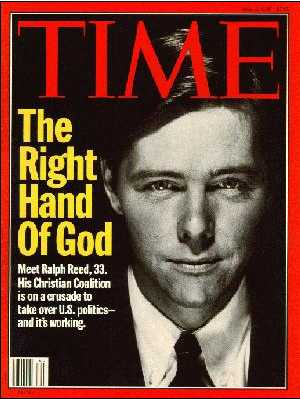
The statewide race that drew national attention ended with a whimper Tuesday night. When it was all said and done, the negatives against the man Time magazine once anointed "The Right Hand of God" proved too great to win the support of the majority of Georgia's Republicans.
Ralph Reed entered the race for lieutenant governor in early 2005 as a runaway favorite to win, with off-the-charts name recognition and a slate of nationally prominent supporters. In the end, though, the former Christian Coalition executive director, Georgia GOP chairman and political operative, who boasted "the most effective, grass-roots, get-out-the-vote effort that this state (had) ever seen in a down-ballot campaign," proved unable to defeat a little-known state senator for his party's nomination.
Ninth-generation Georgian Casey Cagle defeated his Miami-raised opponent - who was running for elective office for the first time amid rampant speculation he was seeking the office only as a steppingstone to the governorship - both by communicating his positive vision for Georgia, and by convincing voters Reed's values were "for sale to the highest bidder."
Cagle's victory is being viewed by many as a triumph of traditional Southern values over corporate, for-profit religiosity, and it unquestionably showed that, regardless of political credentials, character does matter to Georgia's voters. The dark cloud of Reed's association with former lobbyist Jack Abramoff and all the negatives it entailed, from the Indian gaming and money-laundering scandal, to lobbying against regulation of the inhuman working conditions in the Marianas Islands, to, finally, a lawsuit filed a week before the election alleging the pair defrauded a Texas Indian tribe, added up to more than even the smooth-talking icon of the pseudo-Religious Right could weather.
The Republican ticket for November's general election will be stronger with Cagle as the nominee for lieutenant governor. Cagle's 12 years of legislative experience and knowledge of policy issues will benefit him this fall. Should he be elected, he'll be able immediately to work with the Republican majority.
Twenty-one GOP state senators not only endorsed Cagle in the primary, but signed a letter to Reed asking him to drop out of the race for the good of the state and party. This casts doubt on whether Reed would have had any impact on the Senate from the already weak position of lieutenant governor, or whether legislators would have worked to further weaken him and his position, if he had gone on to win the general election.
Beyond his legislative experience and mainstream electoral viability, Cagle improves the GOP's chances this fall - and takes away Democrats' best weapon - simply by not being Ralph Reed. If there was any question which candidate Democrats were prepared to mobilize against this fall, it was answered at the July 9 Atlanta Press Club debate, where Democratic candidates for lieutenant governor spoke repeatedly, not of the need not to defeat the GOP, but to defeat Ralph Reed. Polls repeatedly showed Reed as a drag on the Republican ticket in the general election, a concern for what is still expected to be a tight gubernatorial race. With Cagle as the nominee, that's no longer a factor.
With Cagle, Georgia Republicans have a nominee who can potentially reunite a party bitterly divided by the last year's campaigning. An online poll, hosted by Georgia political Web log Peach Pundit, asked readers whether they would support the lieutenant governor nominee. A whopping 50.8 percent of respondents said they were Cagle supporters, and wouldn't vote for Reed in the general election. In contrast, only 11.5 percent said they were Reed supporters, and wouldn't support Cagle. This polling demonstrated the divisiveness Reed brought to the state and the GOP by running for office while he was a figure in a Washington scandal.
Cagle's against-all-odds victory was a parallel of his life story to this point. He was raised by a single mother, who often worked multiple jobs to provide for her family, but "never took a dime of government assistance." A public school product who never graduated from college, Cagle rose from unskilled laborer to successful self-made business owner. It was that life experience, combined with a desire to do good for Georgia, which propelled Cagle from being such an afterthought in this race that he was one of five attendees at his own candidate tailgate here in Athens last football season - while crowds of people fawned over Reed at his site up the street - to being arguably the greatest political giant-killer in recent memory, if not in Georgia primary history.
• Jeff Emanuel, a Special Operations military veteran who served in Iraq, is a senior at the University of Georgia. He serves as public-relations director for the UGA College Republicans, the largest student political organization in the country. The opinions expressed in his column do not necessarily reflect the opinions of the UGA College Republicans.
Published in the Athens Banner-Herald on 072006
Labels: Elections, Primaries, Republicans
Permalink |
|



Taking on a political celebrity
By Jeff Emanuel
May 12, 2006
Editor's Note: This is the second of a two-part series previewing Georgia's Lieutenant Governor's race. Part I can be read here.
 The most heated Republican primary in Georgia is in full swing this election year, pitting state Senator Casey Cagle against conservative celebrity Ralph Reed.
A "seventh-generation North Georgian," with the accent and down-home manner to prove it, Casey Cagle accurately portrays himself as a living embodiment of the American dream. At the age of three, Cagle's father left him and his brother to be raised by their mother, who often had to work multiple jobs to provide for them—but who "never took a dime of government assistance." A public high school graduate, Cagle went into business at a young age, buying his first company at the age of 20, and quickly building a sizable portfolio of real estate and banking operations.
Running for elective office for the first time at age 28, Cagle defeated an incumbent Democrat to become the first Republican state senator from Hall County in Georgia history, and he has served there for twelve years.
Cagle’s voting record shows a dedication to many conservative issues, and he highlights this (while stressing Reed’s lack of legislative experience) when he speaks of his past achievements and of his goals as Lt. Governor. He touts the last 3 years of Republican leadership in the legislature, expressing pride in having "accomplished things they accomplished," such as "[changing] the entire business income tax structure, [cutting] a billion dollars (he pronounces it "DAH-lehs") in state spending, and [returning] $2 billion to taxpayers."
He also touts the successful Land Conservation Act, which "provides more greenspace and an incentive to keep it" that way, the passage of tort reform, increased spending on high school completion counselors, and the state's AAA bond rating, maintaining that "conservative values are at the forefront in the legislature."
Cagle cites the need to "create more economic opportunities for Georgia," but always takes care to point out that "government does not create jobs, but does create the infrastructure for jobs and businesses to be successful." On the subject of education, he stresses the need to remove the "bureaucracy that ties the hands of every teacher and administrator in our schools, and to allow them to work for what’s best for each child." He has taken a hard line on illegal immigration and on law-enforcement, voting for Georgia’s landmark Security and Immigration Compliance Act, and repeating the favorite quote that "America is a nation of immigrants and we have always welcomed new citizens to our shores. However, there is a right way and wrong way to become an American, and we cannot as a state allow large numbers of individuals to flagrantly violate our laws."
He repeatedly vows also to "continue to protect Georgia family values," citing his "record of 12 years that holds true" to this claim, including receiving the "highest ratings from Georgia Right to Life (he co-sponsored the Pharmacist Protection Act and the Women’s Right to Know Bill, among others), the Christian Coalition," and other organizations.
At each stop on the campaign trail, Cagle takes great care to stress the differences between himself and Reed. Though never addressing his opponent by name, Cagle repeatedly states that "the position of Lieutenant Governor is too important to elect someone who needs on-the-job training," and points out that the Lt. Governor, who "presides over the Senate, has always been elected from within the legislature."
Another frequent refrain of Cagle’s is that his opponent "has been asked by 21 of the 34 Republican Senators to withdraw from the race," which he follows by emphasizing that the winner of this race will have to be able to lead this body and to build consensus, openly questioning whether Reed could possibly function in such a position with so little support from the legislature. He also alludes to Reed’s ethical questions, though he never specifically mentions Jack Abramoff, and contrasts that against his own demonstrated personal "honesty and integrity."
As with any candidate, Cagle has weaknesses (which Reed is quick to highlight), including missed votes in the Senate. Though an avowed supporter of property rights (he has called the Supreme Court’s Kelo decision "very unfortunate," and maintains that in order for land to be condemned, it must clearly be blighted), Cagle was absent from the Senate floor when the vote was taken on Senate Bill 86, which was passed as counter-legislation to a bill (which was later withdrawn) that would have allowed broad use of eminent domain for private development.
Other missed votes include bills allowing excused school absences for children whose parents were in the military and were being deployed or are on leave in the war on terrorism, and providing for increased security at county courthouses. Cagle, who was in Washington the day of those votes, responds by pointing to his "having participated in 95% of votes" in the Senate, and by explaining that he had "conferred with Senate leadership to ensure only non-controversial legislation that was certain of passage was called to the floor [on the day he was absent]. Only one [of these bills] received more than a single vote in opposition, and it passed by a margin of 42 to 7."
Another point of inquiry is Cagle’s donation of $1,000 to then-Lt. Governor candidate Mark Taylor’s 1998 campaign. Cagle openly admits to having donated to the Democrat, but points to Reed, who was involved in Mitch Skandalakis’s campaign for Lt. Governor that year, as a chief reason for his having to do so. Skandalakis ran a commercial claiming that Taylor (an admitted drug user in the 1980s) was currently a drug addict; Taylor sued for libel, and Skandalakis settled after the election.
The commercial’s director maintains that Reed had no knowledge of the spot prior to its airing, but Cagle continues to hold this up as an example of Reed’s "dirty politics," which "are not what we need in Georgia." Cagle and Senate President Pro Tem Eric Johnson donated to Lieutenant Governor-elect Taylor (who is now running for Governor), Cagle says, so that the then-minority Republicans "would not be shut out of" decent committee assignments, and "would be able to have their legislation considered on the Senate floor"—an example, he says, of the give-and-take necessary to be an effective legislator, which he repeats that Reed does not have the experience to understand.
Though not the smoothest public speaker in Georgia politics (or even in this race), Cagle exudes an enthusiasm so great that any audience he addresses cannot help but absorb and reflect it. Georgians appear to be buying into Cagle in better-than-expected numbers, as evidenced by the relatively small number of big-money donors who have contributed to Cagle’s $1.4 million war chest, which has been raised almost entirely within the state of Georgia. The amount itself is not unimpressive, considering Georgia legislators are not allowed to raise money during the legislative session.
A recent poll by Matt Towery showed Cagle trailing Reed by 7 points (1/3 of the deficit from a few months ago), but both campaigns have touted polls which show their candidate "in the lead," and there is no doubt that much will happen between now and the July primary. Georgia Republicans are bitterly divided over this race, although it certainly appears that Cagle has less to lose from a campaign which is bound to get more, rather than less, negative as voting day approaches.
Jeff Emanuel, a Special Operations military veteran, studies Classics at the University of Georgia. He is also a contributing editor for conservative web log RedState.com, and is a columnist for the Athens, GA Banner-Herald newspaper.
Copyright © 2006 Townhall.com
Labels: Georgia, Primaries, Republicans
Permalink |
|
Who is Ralph Reed?
By Jeff Emanuel
May 10, 2006
Editor's Note: Townhall.com is previewing the Lieutenant Governor's race in Georgia, as it is one that has garnered national attention. A feature on Casey Cagle, Mr. Reed's Republican primary opponent, will run Friday.
Ralph Reed, former Chairman of the Georgia Republican Party and first Executive Director of the Christian Coalition, is running against Georgia state Senator Casey Cagle in the state’s most heated primary, for the office of Lieutenant Governor.Reed was born in Virginia, and moved from Miami to Toccoa, Georgia, at the age of 15. He attended college at the University of Georgia and went on to earn a Ph.D. in American History from Atlanta’s prestigious Emory University. A self-described "mainstream, balanced-budget, tax-cutting conservative" who is "running unapologetically on his values," Reed presents himself as a visionary in his first attempt at public office, promoting a "sound public policy that includes every one of our citizens." He compares himself to the late President Reagan, like whom he wants to "unfurl a banner not of pale pastels, but of bold colors," and says that being the son of a Vietnam veteran taught him "that there are certain values and principles, like freedom, worth fighting and dying for."
A veteran of in-the-trenches electoral politics who refers to himself as a "grassroots candidate," Reed continuously reiterates the party’s goals for the year: reelecting Governor Sonny Perdue (the first Republican in that office since Reconstruction) and adding to the Republican majorities in both houses of Georgia’s General Assembly. He also addresses his personal goal of "establishing the position of the Lt. Governor as the philosophical ally of Gov. Perdue, rather than an opponent" (for the duration of Perdue’s term, the Lt. Governor has been Democrat Mark Taylor), and to "restore that office to effectiveness," so that it can "be a leadership slot for conservative values."
Both educated and articulate, the man Time magazine once called “The Right Hand of God” is an extremely gifted public speaker who exudes knowledge and is conversant on almost any issue. Reed backs up his talk with what he calls "the most comprehensive agenda of any Lt. Governor candidate." He has over 40 pages of issues-related material on his website, which covers every foreseeable topic he could possibly have a chance to impact during his prospective term as Lt. Governor, and he repeatedly reiterates his status as the "first candidate in this race" to address many of them.
His "Grow Georgia" plan includes lowering the state income tax (which, he loves to point out, is "higher than 'Taxachusetts'"), “eliminating the capital gains tax," and "promoting a "Taxpayer Dividend Act" which, after allowing for annual population growth and inflation, [would] dedicate ¼ of any budget surplus to education and ¼ to bonds (to maintain Georgia's AAA bond rating), and [would] return the rest to the taxpayers," as "money belongs to the citizens" and, as shown in the 1980s and the 2000s, "economic growth is spurred by lower tax rates."
Reed also supports a constitutional amendment to protect private property rights, maintaining that it is "very important to oppose eminent domain abuse," as the three "foundational human freedoms are life, liberty, and the right to own property," and "true freedom includes the right to control and own property." On the topic of immigration, Reed is strongly opposed "amnesty in all forms," and cites the need to "protect the borders." He supports the state’s recently enacted Voter ID law, and is in favor of a “comprehensive audit of the current voting rolls.” On family-values issues, he continues to reiterate his strong pro-life stance.
Reed favors a HOPE scholarship amendment to “protect funding” for Georgia’s unique merit-based college scholarship program, and to “make home-schoolers eligible for immediate benefit." He has also proposed a program called "Charters for Choice", which would determine failing schools (low test scores for three straight years, a graduation rate of under 50%, and other determinants), and would provide scholarships for students from these schools to go to private or religious schools, be home schooled, or transfer to a public school of their choice.
A proponent of joint-enrollment and vocational training, Reed calls a good education a "basic civil right," and cites a Harvard study which showed that school choice and competition is "more effective in raising test scores and improving schools" than the fixes instituted by Ted Kennedy’s No Child Left Behind Act. “When two professors from Harvard agree on the effectiveness of school competition,” he loves to say, “That’s what I call consensus.”
Unfortunately for both candidates, consensus among Georgia’s Republicans is hard to come by in this race. Supporters are quick to flaunt their opponent’s weaknesses, and Reed’s background, though providing him with a network of national contacts whose aid he could potentially enlist to help enact his agenda as Lt. Governor, makes him a polarizing figure. Cagle harps on Reed’s lack of legislative experience (though Reed generally refrains from personally attacking Cagle), and anti-Reed bloggers have jumped all over his decision to make his first run for office “in the same cycle that he is a figure in the biggest scandal to hit Washington in the past decade,” saying that it “hurts the party.” This is backed by a recent Matt Towery poll, which shows Reed 7 points ahead of Cagle, but also has him as an 8 point drag on the GOP ticket this fall.
A Reed campaign worker pointed out that the Abramoff casino gaming situation, which Reed calls “an attempt by the liberal media and others to engage in guilt by association,” was “nothing to worry about,” as Abramoff has already been tried and sentenced, so “if there were any truth to the allegations, something would have happened by now, and Georgia’s voters know that.” Still, the campaign is worried enough about the situation that Reed feels the need to address it at the end of almost every speech, saying “if I had known then what I know now, I never would have” worked with Abramoff, but always pointing out that his part in the affair “helped protect countless families from the dangers of online gambling.”
Regardless of the lack of anything more substantial than spoken allegations against Reed, the situation has provided fodder for Democrat and pro-Cagle bloggers, who repeatedly point out that he is “the only candidate [in this race] who has a criminal defense attorney.” This has not stopped big-name Republicans Rudy Giuliani and Newt Gingrich from helping him in this election, though, as both have appeared at Reed fundraisers this year. Several other national figures are also solidly behind Reed’s candidacy.
This contest, which pits two very different candidates with impressive resumes against each other for their party’s nomination, is inarguably the most contentious battle in Georgia this year, dividing the GOP across the state. Appearing at a March fundraising event for the Georgia GOP and the Perdue campaign, President Bush refused to inject himself into the race, saying only that there are “two candidates running for lieutenant governor, Casey Cagle and Ralph Reed, [and] we appreciate them both being here tonight.”
The race is a statistical dead heat, and who will emerge from the July 18 primary as the party’s nominee is anybody’s guess. Both campaigns tout polls which show their candidate in the lead, and the tone of the race will most likely grow more negative over the next two months. What is inarguable, though, is that both of these candidates have a clearly articulated vision for a better Georgia, and for their role in making that happen. The greatest worry among Georgia’s Republicans must be that the primary will take such a toll on the winner that he will be irreparably damaged heading into what promises to be an extremely tough general election.
Jeff Emanuel, a Special Operations military veteran, studies Classics at the University of Georgia. He is also a contributing editor for conservative web log RedState.com, and is a columnist for the Athens, GA Banner-Herald newspaper.
Copyright © 2006 Townhall.com
Labels: Georgia, Primaries, Republicans, Scandals
Permalink |
|