Shocker in Georgia's 10th Congressional District: Paul Broun, Jr. turns the conventional wisdom on its head

 Georgia’s 10th Congressional District was turned upside down this week, as a 9-to-1 frontrunner -- and conventional wisdom -- fell victim to the less-predictable-than-originally-thought voting public. In an all-Republican runoff to fill the seat left open by the late Rep. Charlie Norwood (R-Ga.), conservative physician and professional candidate Paul Broun, Jr. of Athens rocked the political boat by pulling off a 50.4% to 49.6% victory -- a 394-vote margin -- over heavy favorite Jim Whitehead, a state Senator and small business owner from Augusta. Whitehead was the expected winner after coming out on top of the ten-candidate June 19 special election with 43.5% of the vote to Broun’s 20.7%.
Broun, by conventional thinking, should have lost. He was at a natural disadvantage based on the demographics of the district. The 10th CD is mainly comprised of Augusta, which is home of the Masters golf tournament and of the Medical College of Georgia (where Broun earned his MD), and of Athens-Clarke County, is the most liberal county in the northeastern part of the state, and home of the University of Georgia, where Whitehead once played football. Being from Athens -- while his opponent was from Augusta -- meant that in order to win, Broun needed not only to pick up conservative votes in the more rural areas outside of the two major cities, but to gain Democrat votes in far-left Athens and pick off enough support from Whitehead’s end of the district to make the votes from any of those other areas matter.
Trolling for votes in Athens was the touchiest part of his campaign, given the fact that Broun’s past positions, which have included the eradication of “unconstitutional” programs like Social Security and Medicare, are about as far out of that area's mainstream as one can get.
In the days and weeks leading up to the runoff, though, Broun’s strategy appeared to be faltering. The situation culminated in an incident involving his wife Niki, who sent out an email to friends within the district, which she requested be “forward[ed] to REAL Christians,” and in which she alleged that “the enemy” and their “opponent” were ganging up on she and her husband, while calling into question “Jim Whitehead’s spiritual condition.”
Georgia political blog Peach Pundit’s breaking of the story of the email (which was picked up by the Atlanta Journal-Constitution) caused Broun to write a harshly-worded email of his own to the paper regarding their failure to “accurately” report about the email in question, saying that it never originated from his “campaign” and that his wife “never meant for her email to be for wide spread distribution.”
Regardless of intent, this situation -- which Peach Pundit referred to as a “Paul Broun Melt Doun” -- made it appear that Broun was sinking in the final weeks of the campaign.
Further compounding Broun’s problems were several other weaknesses that Whitehead should have been able to use to his advantage, including: (1) Broun was allegedly campaigning for Norwood’s seat as far back as two years ago, when the late Congressman was ill but still in office; (2) Broun stakes his professional name on being a physician, despite the fact that he was recently fined for practicing without a license; (3) Broun created an embarrassing scene by strong-arming a local party on his end of the district into rescinding their pre-election endorsement of his opponent; and (4) Broun ran for national office several times previously, in different parts of the state -- basically serving as a professional traveling candidate for Congress.
Given Broun’s disadvantages and the fact that the entire Republican delegation in the state Senate had endorsed Whitehead, the only question -- at least on paper -- seemed to be by what margin Whitehead would win. Real elections, though, are played out at the ballot box, and not on paper, as the voters in GA 10 (and the pundits who were watching, confident of a Whitehead cakewalk) saw on Tuesday.
While most critics and pundits were hung up on Broun’s disadvantages -- and while the Whitehead camp sat idly by, treating the runoff election like a mere formality -- the underdog simply executed his strategy, and it paid off beautifully. He managed to take nearly a third of the votes in Whitehead’s home county, and in Athens he hammered Whitehead by an unthinkable 5,122 to 601 (or 9 to 1) vote margin. In the district as a whole, Whitehead received 455 fewer votes in the runoff than he did in the June 19 special election (from 23,555 to 23,100), and Broun increased his vote total by over one hundred percent, from 11,208 to 23,473.
How did such a dramatic turnaround happen -- especially in a state where, when the leader going into a runoff earned more than 30% of the vote in the initial election, the odds in his favor are nearly 9-to-1?
It didn’t take long for the finger pointing to begin inside the Whitehead camp; however, the mistakes made are more cut-and-dried than they appear at first glance. In essence, it was a case of writing off the runoff election as a formality, and started picking out furniture for the DC office.
Specifically, Whitehead hired on the late Rep. Norwood’s old staff early in the campaign, a smart move for somebody looking to project the continuation of an administration most in the district had been overwhelmingly happy with for years. He also retained one of the top political consultants in the state, Joel McElhannon, to actually run his campaign. To quote an insider, the Norwood holdovers “were quite happy letting Joel call shots during the primary, but once it was over and they had such a commanding lead, they shoved the in-state consultant, Joel, aside, and prepared for the swearing in ceremony.”
During the three weeks of the runoff, the Whitehead campaign did next to nothing, sitting in Augusta and eschewing any temptation to spend money on mailings or television spots, or to spend effort on walking from door to door. The only action taken was a small number of appearances by the candidate -- and in one of these, he exercised his main weakness: his penchant for sometimes speaking first and thinking later. In this case, he said in essence that the election would determine whether Augusta or Athens was the city that mattered in the 10th CD -- and true to his word, the campaign completely wrote the western end of the district off for the duration of the run-up to the election.
Paul Broun did not. He worked in Athens, telling the people there that Jim Whitehead, if elected, would ignore them (a fact borne out by Whitehead’s treatment of the town during the campaign); he worked in Augusta; and he worked in between. The airwaves, newspapers, and people’s mail boxes were flooded with the message and likeness of Paul Broun, while Jim Whitehead simply let his opponent have the initiative -- and it came back to bite him, hard.
Regardless of the election’s outcome, Georgia’s 10th CD -- and Congress -- would have gained another conservative Republican. With Paul Broun’s victory, the GOP has gained a self-described “strict constitutionalist” who is committed to “restor[ing] government according to the Constitution as our Founders intended.” Broun has said that he, like Rep. Ron Paul (R-Tex.), will “always carry a pocket Constitution” on his person while in Congress, and will “apply a four-way test to all legislation” (in essence, is each piece of legislation constitutional, moral, needed, and affordable?).
Broun is a proponent of private property rights, an opponent of illegal immigration, and a supporter of the Fair Tax, or national sales tax (as well as the abolition of the IRS.) He is a member of the National Rifle Association and president of the local affiliate, the Georgia Sport Shooting Association. Further, he is pro-religious freedom, and is very outspoken against “the ACLU and Activist Federal Judges,” who he says are “destroying America's heritage of religious freedom and religious expression.”
He came from behind to make a runoff for Rep. Norwood’s open seat. He came from behind to win that runoff, and to make it to the US House of Representatives. All pride and petty quibbles aside, Georgia Republicans have to feel good about having a staunch conservative with that kind of work ethic representing them in Congress for many years to come.
Jeff Emanuel, a special operations military veteran, is an Athens, GA resident and an administrator of Georgia political weblog Peach Pundit. In addition, he is a columnist and a director of conservative weblog RedState.com.
Labels: Elections, Georgia, Special Election
Permalink |
|


Election Day in Georgia’s Tenth Congressional District: Filling the shoes of a conservative icon

Tuesday, July 17
Today in Georgia’s Tenth Congressional District, voters will go to the polls to elect the successor to the late Rep. Charlie Norwood (R-GA). The 65-year-old member of the 1994 “Republican Revolution,” who died at his Augusta home on February 13 of this year, was a was a solid Republican and a conservative icon, having earned a 96% lifetime rating from the American Conservative Union. Dr. Norwood was respected and liked by voters on both sides of the aisle – a fact which was demonstrated by his electoral performance in the district. Despite redistricting in 1996 and 2002, he never received less than 52.3% of the vote (in 1996), and received more than 60% five times, including twice surpassing 70%. Between his popularity and his solid conservative stance on the issues, Norwood left some very, very big shoes to fill.
The race to fill that open seat was an entertaining free-for-all involving ten candidates (six Republicans, three Democrats, and one Libertarian). The slate presented to voters in the special election last month (June 19) consisted of a prominent Republican grassroots activist, a medical doctor, a former lineman for the Georgia Bulldogs, a Yahoo! executive, an Iraq war veteran, and several other marginal candidates.
State Senator Jim Whitehead, a 65-year-old Republican from Augusta who is a relative newcomer to politics, having been elected to his first public position (Columbia County Commission) in 1994, was the clear frontrunner in the special election. The question going in that day was whether the other nine candidates would combine for enough of the vote to prevent Whitehead from reaching 50% - and, if that happened, which challenger would finish in second place overall, and thus gain a spot in a runoff election.
Whitehead received 43.5% of the vote in the special election, with Athens Republican Paul Broun, Jr. coming in second with 20.7% (only 198 votes ahead of Atlanta Democrat and former Yahoo! executive James Marlow). With that, the race to fill the Georgia’s 10th CD became a glorified primary, with two Republicans squaring off in a largely GOP district, each trying to outdo the other to win over the voters.
Jim Whitehead, a former Georgia football player, Methodist churchgoer, and current small business owner, is a conservative Republican who just finished his third year (one and a half terms) in the State Senate. His beliefs line up with most Republicans in the district: he is for improved border security, against amnesty for illegal aliens, in favor of local control of education, and against pork barrel spending.
A humble man who is fully aware of who and what he is running to replace in the 10th CD (and who astutely hired most of Norwood’s staff onto his campaign), Whitehead’s catchphrase this election season has been, “I can’t be Charlie Norwood – but I can be Jim Whitehead, and I am running to protect and continue Charlie’s legacy of conservative leadership.” Whitehead comes across in person as a man who is selling nothing but himself; however, whether that will be good enough to win today’s runoff remains to be seen.
Whitehead’s only major potential pitfall in this and future elections is his penchant for sometimes speaking first and thinking later. This mark of someone who is not a professional politician has gotten him into trouble from time to time, especially with the editors of the fairly liberal Athens daily newspaper; however, it did not hurt him enough to put his June 19 victory in doubt, and likely will not hurt him too badly today, either.
Paul Broun, Jr., the underdog in today’s runoff election, is an Athens physician. His father of the same name was a state legislator for 38 years, albeit as a Democrat; however, his name endures in the Athens area, as the main highway circling the city is known as the Paul Broun Parkway. The Paul Broun running in this election, though, is light-years apart ideologically from his more liberal father. A self-described “strict constitutionalist” who is committed to “restor[ing] government according to the Constitution as our Founders intended,” Broun has said that he, like Rep. Ron Paul (R-TX), will “always carry a pocket Constitution” on his person while in Congress, and will “apply a four-way test to all legislation” (in essence, is each piece of legislation constitutional, moral, needed, and affordable?).
Broun is a proponent of private property rights, an opponent of illegal immigration, and a supporter of the FairTax, or national sales tax (as well as the abolition of the IRS). He is a member of the National Rifle Association and president of the local affiliate, the Georgia Sport Shooting Association. Further, he is pro-religious freedom, and is very outspoken against “the ACLU and Activist Federal Judges,” who he says are “destroying America's heritage of religious freedom and religious expression.”
Most of these positions fit relatively well with the overall position of the district. However, Broun is at a natural disadvantage in the race, which stems from the fact that he is from the area within the district which is home to the most liberal segment of the population, and the fact that his past positions (which have included supporting the eradication of “unconstitutional” programs like social security and medicare) are as far out of the mainstream of that area as one can get.
The 10th CD is mainly comprised of Augusta, which is home of the Masters golf tournament and of the Medical College of Georgia (where Broun earned his MD), and of Athens-Clarke County, which is home to the University of Georgia and is the most liberal county in the northeastern part of the state. Broun’s campaign strategy reflected this reality from the beginning of the runoff; while trying to convince voters at the Augusta end of the district that he is a staunch conservative who will “let the Bible guide” him in all he does, Broun has been trying to rally the Athens Democratic machine to his standard as well, in hopes of gaining enough votes from both ends of the spectrum to beat out the more moderate (by comparison) Whitehead. However, in recent days and weeks, his attempts to play to both sides of the district have increasingly backfired, leading to moves of increasing apparent desperation, including his wife Niki sending out an email to people within the district, which she requested be “forward[ed] to REAL Christians,” in which she (astoundingly) alleged that “the enemy” and their “opponent” were ganging up on she and her husband, and called into question “Jim Whitehead’s spiritual condition.”
Georgia political blog Peach Pundit’s breaking of the story of this email’s existence, which was picked up by the Atlanta Journal-Constitution, caused Broun to write a harshly worded email to the paper regarding their failure to “accurately” report about the email in question, saying that it never originated from his “campaign” and that his wife “never meant for her email to be for wide spread distribution.”
Regardless of intent, this situation – which Peach Pundit referred to as a “Paul Broun Melt Doun” – highlights the issues that the Broun campaign has had in the final weeks of this runoff election with its initial position as an underdog, and with necessary strategy of trying to attract polar opposite ends of the political spectrum to the same standard.
Further compounding this are past problems which Whitehead has been able to use to his advantage – the fact that Broun was allegedly campaigning for Norwood’s seat as far back as two years ago, when the late Congressman was ill but still in office, the fact that he stakes his professional name on being a physician despite the fact that he was recently fined for practicing without a license, and the fact that he has run for national office several times previously, in different parts of the state.
Given the combination of disadvantages being experienced by Broun, the only question today – at least on paper – seems to be what margin Whitehead will win by. However, given the fact that elections are played out in the real world, not on paper, and that few expected Broun to make the runoff in the first place, it would be foolish to write off the professional candidate completely.
Regardless of outcome, though, at the end of the day Georgia will have kept its 10th Congressional District Republican, and will have another vocal conservative on Capitol Hill. Anything more than that, as they say, would be a bonus.
Jeff Emanuel, a special operations military veteran, is an Athens, GA resident and an administrator of Georgia political weblog Peach Pundit. In addition, he is a columnist and a director of conservative weblog RedState.com.
Labels: Georgia, Special Election
Permalink |
|
Rest in Peace, Charlie Norwood
 Mourning the loss of a Conservative Lion
 Charlie Norwood, six-term GOP Representative from Georgia’s 10th Congressional District, passed away at his Augusta, GA home yesterday. The ailing Congressman’s death came only days after he declined further medical treatment in Washington for non-small-cell lung cancer, and returned home to hospice care, and to be with his family in the last days of his life.
Norwood had also battled idiopathic pulmonary fibrosis (IPF) for years, being diagnosed with the condition in 1998 and receiving a lung transplant in 2004 as treatment.
A member of the 1994 “Republican Revolution,” the sixty-five year old Congressman worked tirelessly on several issues of importance both to his state and to the nation. An Army veteran himself, with two Bronze Stars earned in Vietnam, he spearheaded the effort to secure full medical coverage for military retirees, co-authoring the Keep Our Promises to Military Retirees Act.
He also worked with the Governor of Georgia on a plan to preserve federal funding in support of Georgia’s State Children’s Health Insurance Plan (SCHIP), also known as “Peach Care,” and fought for other comprehensive healthcare reform measures.
Norwood did his part to represent Americans across the political and economic spectrum. He championed the needs of individuals, such as special needs students, for whom he authored the Discipline Reform Amendment to the Individuals with Disabilities Education Act, and he also worked to improve industries, like broadcast television, for which he authored Community Broadcasting Protection Act.
Norwood’s congressional legacy was set up to live on in the 110th Congress with the reintroduction Monday of his signature legislation, the “Patient’s Bill of Rights.” Known as the “Consensus Managed Care Improvement Act of 2007” and co-sponsored by Democrat David Dingell of Michigan, this legislation, if passed, would reinstate the rights of medical patients to sue federally-governed health plans in state court for injury or death-causing medical decisions and improper denials of care – an ability lost to the public with the 1974 passage of the Employee Retirement Income Security Act (ERISA).
Shortly before his death, Norwood wrote that, given the leadership positions of several Democrats who had in the past supported the Patient’s Bill of Rights, there was “no reason” that the 110th Congress couldn’t “pass the original, un-compromised bill with a veto-proof majority.”
“At the last poll,” he concluded, “the Patient’s Bill of Rights had an 82% public approval rating. If the Democrats can use their new majority to pull that off, they will and should score big with the public.”
Norwood was a rock-solid conservative on many issues, from taxation (he was a “FairTax,” or national income tax, supporter) to immigration. The author of a provision in the 2005 Deficit Reduction Act which required that Medicaid recipients verify US citizenship, he also supported a security fence along the US’s southern border, supported fines on businesses which employed illegal aliens, and opposed any form of amnesty for undocumented immigrants. He was staunchly pro-life, and supported school vouchers as a means of “returning decision-making to families” – something at the heart of the core conservative pro-choice and pro-personal-responsibility philosophy.
Though his views on many of these issues put him in direct opposition to most core Democrat issues and principles, the overall sentiment toward the late Congressman has largely been both warm and respectful from both sides of the aisle. Both Republican and Democratic commenters on Georgia political blog “Peach Pundit” have attested to the fact that, regardless of political affiliation, there was never any doubt that Dr. Norwood “put the interests of his constituents, his state, and his country first,” and professed admiration for a “good and honorable man who dedicated his life to public service and to serving his constituents to the best of his ability.”
Norwood’s popularity in his congressional district was inarguable. Despite redistricting in 1996 and 2002, he never received less than 52.3% of the vote (in 1996), and received over 60% of the vote five times, including twice over seventy percent. His reelection in 2006, unfortunately was his last.
With Norwood’s passing, Governor Perdue will be required, by the end of next week, to submit to Secretary of State Karen Handel a proposed date, at least thirty days away, for a special election. There are countless names being mentioned as potential candidates for that seat, although all but one have been smart enough not to announce their candidacy yet, instead opting to wait out of respect for Dr. Norwood and his family.
The show, as they say, will go on in the 10th Congressional District, and in the US House of Representatives. However, it will be a bit less
warm and a bit less colorful for the loss of this great man. Conservatives this week lost an icon and a champion of their cause and their values; more importantly, though, the Norwoods lost a beloved family member, and many, many more around Georgia and around the country lost a dear, dear friend.
Rest in Peace, Congressman. For those who knew you, it was an honor; for those who didn’t, it was an opportunity missed to know a great man; and for those whose lives you touched through your endless dedication to public service – which was all of us, regardless of ideology or affiliation – it was an experience for which we wouldn’t trade anything in the world.
Mr. Emanuel, a special operations military veteran, is a leadership fellow with the Center for International Trade and Security at the University of Georgia, where he also studies Classics. In addition, he is a contributing editor for conservative weblog RedState.com, and is a columnist for the Athens, GA Banner-Herald newspaper.

Permalink |
|
Broun vs. the AJC: It’s a Paul Broun Melt Doun! (and, “The fight against Whitehead, Whitehead, and Satan”)
cross-posted at Peach Pundit
The campaign of Paul Broun, Jr., winding down and apparently getting ready to finish with a resounding whimper, is demonstrative of both his age and his inability to adapt to technology and communications advances. An old Gray in an iPhone age, Dr. Broun's campaign may come to set the standard for how a campaign should not be run in the New Media era -- and is demonstrating the perils of attempting to selectively use some technological advances, while choosing to ignore others.
Trying to run two different races in two different areas -- say, Athens and Augusta -- is much more difficult now than it was in the past, because people from both places have access (via this series of tubes we call the internets) to what was said elsewhere. Radio, newspaper, and television appearances are accessible to people everywhere moments after they air, making it much tougher to get away with lying about, or mischaracterizing, positions and actions.
There are plenty of examples -- simply search "Paul Broun" on this site for more than you can read in a day -- but this latest and greatest has to take the cake. If his campaign hadn't shown such total ineptitude -- both in terms of being consistent and in terms of understanding New Media to such a rudimentary degree that they realize that what they say and send will get out -- then I'd go ahead and call this a full-on election-eve "Paul Broun Melt Doun."
Heck, let's call it that anyway; after all, it sure seems to be. Check out this latest development:
As we broke the story here at PP, Broun's wife sent an email to her list asking that it be forwarded on to certain people who met the certain standard which the Brouns seem to think is a requirement for participating in our representative Republic. The email was lengthy, but here's the important part:
From: Nikibroun@[redacted]Non-"REAL Christians," of course, need not apply. Further:
Sent: Thursday, July 12, 2007 3:24 PM
To: [redacted]
Subject: P and N Broun testimony
Hi [redacted],
Please read the following synopsis of our testimonies. If you feel so led, please forward it to the REAL Christians in your email address book. I believe that Christians can make a big difference in this race and networking is one way to spread the word.Thanks!
Paul Jr. my husband, is running for the seat vacated by Charlie Norwood's death. We have been under such attack; it's too long to go into here. I just ask you and your friends to pray for us. The enemy is coming against us with such fury it's scary. Our opponent is not being all that nice either.Check the last two sentences. Apparently (and perhaps it's obvious if you're a "REAL Christian") Broun is not only fighting the two Jim Whiteheads, but Satan himself as well! (You know what a special place in Satan's cold, black heart GA's 10th CD has always held. Fight on, Paul...)
It is not my place to judge Jim Whitehead's spiritual condition but I'll just tell you that a pastor in Hartwell invited Paul and Mr. Whitehead to speak at his church. Paul accepted gladly, as he has in many churches. Mr. Whitehead said he felt uncomfortable speaking in churches and didn't think you should mix church and state.We could rephrase that first sentence: "It is not my place to judge Jim Whitehead's spiritual condition but" I'm going to anyway, and since he is against us, and (based on the paragraph above) Satan is against us, then Q.E.D. he is working with Satan!!
Paul feels that as a Congressman, he would be a missionary to government. And don't we need that!! He is profoundly pro-life and as a medical doctor he can fight abortion on a physiological level, beyond his spiritual beliefs of the sanctity of life. (He did run for office in 1990 as pro-choice before God removed the scales from both of our eyes about that important issue.)Here we get into that whole disparate-messages issue. You see, Paul Broun wants to be "a missionary to government," and says that the Bible will serve as his guide. Is his campaign so inept that nobody realizes that the Liberals in Athens whom they are trying to woo in hopes of ganging up on Whitehead will hear that message as well? Wow.
Here's the real kicker, though. The AJC's Political Insider, one of our favorite sites here at PP, picked up our coverage of the above letter, and the result was (predictably) a Brian Passante-esque Paul Broun Melt Doun of the first order. This morning, Paul Broun sent an email to Jim Galloway of the AJCPI in which he slammed Peach Pundit, implied that Galloway was dishonest and irresponsible, and demanded a correction. Peach Pundit has obtained a copy of that email, and the full text is posted below (with commentary, of course ;-) ).
07/16/07 09:44 AMSo should campaigning, Dr. Broun, as you so often remind us all (both with your statements to that effect, and your actions otherwise).
To: Jim Galloway
From: Paul Broun
Subject: From Paul Broun re Niki's email
Mr. Galloway:
You are in the news business. News should be premised upon accuracy.
Political Insider posted an allegation gathered from Peach Pundit that "the Broun campaign" sent an email appealing for support from "real Christians."Ah, yes. The wife of the candidate sending such an email as that detailed above is a massive, massive difference from the campaign doing so. Please accept our apologies, Dr. Broun, and please instruct your wife that emails are forwardable. I understand that it may be as difficult a concept to understand as is the fact that what you say in one end of a Congressional district, and to one audience, will actually reach other people -- including those to whom you have said completely different things; however, such is the reality of this New Media, lightning-fast communication era in which we live.
Just because Peach Pundit says that the Broun campaign did it, does not make it so! The claim is erroneous. Therefore, a correction is in order.
The facts are these:
1. The Paul Broun Committee absolutely did not send that email.
2. Independent of the campaign, in a loving attempt to help me, my wife emailed a few of her friends. She was basically asking them to pray for us and to do what they could to get their friends to turn out and vote. This is a wise thing in a mid-summer special run-off election projected to have low voter participation. Niki never meant for her email to be for wide spread distribution.
3. I am glad that Niki, my wife of almost 23 years, loves me and was trying to help. The portion of the email that shares our testimonies [and which you did not include] is accurate.
4. However, in her zeal to be helpful, and feeling the pressures that come with a political campaign (which may be tougher on the spouse than the candidate), she went beyond what she should have. Appearing to question Mr. Whitehead’s spirituality was inappropriate. She and I have discussed this matter. We feel an apology to Jim and Peggy is in order. And I do apologize to them.
Dr. Broun prides himself on performing house calls in his medical practice -- a practice reminiscent of a time long forgotten. His style of campaigning, and a goodly amount of his message (as well as his outrage), appear to belong in the distant past, as well.
Labels: 10th CD, Georgia, Special Election
Permalink |
|

Davis looks to unseat McKinney
By Jeff Emanuel
June 23, 2006 The name Cynthia McKinney is almost guaranteed to elicit a reaction of some sort from Americans across the political spectrum. Last seen attempting to justify her striking of a Capitol Hill police officer by decrying his “racism” and “inappropriate touching,” the maverick Representative from Georgia’s predominantly Democrat 4th Congressional District has rarely been out of the news during her term in office—though she has rarely been in it for good reasons. Change for the better could be on the horizon, though, as—for the first time in a decade—McKinney appears to have a serious challenger from across the aisle.
Catherine Davis, a relative newcomer to Georgia politics, has rejoined the race for the 4th District seat (she ran in 2004 and lost, but in a far less anti-McKinney climate), citing McKinney's "dismal legislative record and her outrageous behavior,” which she calls “an embarrassment to the hard-working folks” in the district. A single parent, Davis currently serves as Sprint-Nextel’s Human Resources Manager for the South. She was educated at Tufts (graduated Magna Cum Laude in three years with a double major), and earned her Juris Doctor from the University of Bridgeport.
A black Republican, Davis is conservative on nearly every issue. She is a fiscal conservative who supports the partial privatization of Social Security, as well as the scrapping of the current tax code and the IRS in favor of the Fair Tax. On immigration, she is a proponent of securing the borders first; on health care, she favors personal health savings accounts.
Education may be one of Davis’s strongest issues. A firm believer that “studying hard and getting a good education [is the] key to achieving a better, more prosperous life,” she is a strong supporter of charter and home schools, and favors vouchers and tax credits to assist in school choice. Perhaps most importantly, Davis is a stable, sensible professional who does not have a track record of her mouth or her actions getting her in hot water—making her an almost perfect anti-McKinney.
Cynthia McKinney, as usual, is almost as far left—and as nonsensical—as possible on a host of issues. She claims that “Republican priorities do not include education for our children,” saying that “federal tax cuts for the wealthy and funding for the war come at the expense of education and our children.” She decries “wasteful government spending,” but says that the “most notable” examples of this are “resources improperly devoted to the war in Iraq and corrupt and fraudulent military contractors.” A self-described proponent of “energy efficiency [and] sustainable power sources,” McKinney brags that she has “consistently voted” against drilling in the Arctic National Wildlife Refuge.
She is vocally anti-Bush and anti-defense; her outrageous statements regarding September 11 (“What did this administration know and when did it know it, about the events of September 11? Who else knew, and why did they not warn the innocent people of New York who were needlessly murdered?”) and the Iraq war (“Thousands of Iraqis, especially children, have been killed by our sanctions and our bombs...[but] destroying Iraq isn't enough for them”) are well-documented. Her anti-American rhetoric, which could be mistaken for that of Hugo Chavez himself, includes gems like this one: “Democracy in Venezuela, India, Spain, Brazil, Chile, Argentina, and Uruguay has produced proud people willing to stand up to US imperialism, coup attempts, and destabilization of their countries. And the good news is that this resistance will spread.” She has followed up with such mind-boggling assertions as “George Bush came to power by stopping democracy at home—denying the opportunity to vote to blacks and Latinos in Florida,” and, “in countries like Haiti where democracy was thriving, [the American government] arrested President Aristide at gunpoint and forced him out of his own country.” To quote loosely from the fairytale film The Princess Bride, when the Dread Pirate Roberts was engaged in a Battle of Wits with the Sicilian, Vizzini: truly, she has a dizzying intellect.
Almost two-thirds of the Economics portion of McKinney’s website is dedicated to decrying “Pentagon fraud, waste, and abuse” and the “shameful contracting practices of the Bush Administration,” which is especially grave in its “treatment of…minority business owners.” She is a staunch supporter of Title IX, the 1972 law which imposed sex discrimination in educational programs that receive federal funding, requiring them to cut programs for males if there was a higher percentage of male participation than the percentage of males in the student body.
McKinney has an eyebrow-raising record of sponsored legislation, from the Tupac Shakur and Martin Luther King, Jr. records release Acts, to a resolution “reaffirm[ing] the continued importance and applicability of the Posse Comitatus Act,” to a resolution “opposing any agreement between” the US and Nigeria to “deploy United States Armed Forces to Nigeria.” Worthy causes all, to be sure, and issues which are on the front burner of concern for all Americans.
The most intriguing part of McKinney’s campaign outreach platform—and one which has received prominent positioning on her website—has to be her self-described status as “a strong advocate, mentor and supporter of the Hip-Hop community.” She credits her “unique popularity among the members of the Hip-Hop generation” for her becoming a “trusted voice on behalf of producers, retailers and consumers of Hip-Hop entertainment.” She cites the “potential of the Hip-Hop community” to “evolve into one of the strongest movements on behalf of social justice and community development.” As her website claims, “Congresswoman McKinney is responsible for special outreach to the Hip Hop community and supports their efforts to run for office and become policymakers for today and tomorrow.” It would appear that rappers such as Kanye West (of “George Bush doesn't care about black people” fame), Fifty Cent (who filmed a DVD to “take viewers inside his X-rated hip-hop lifestyle”), and others currently have a friend in Congress, and a supporter should they ever decide to run for office.
Cynthia McKinney has proved beatable in the past, losing the 2002 4th District primary to fellow Democrat Denise Majette (her father attributed the loss to the fact that "Jews have bought everybody. Jews. J-E-W-S.") Whether she is beatable by a Republican—even a black one—remains to be seen.
"While in the past simply being a Democrat was enough to get you elected," says Davis, "I believe the voters of the 4th are shifting and they're looking for leadership. I also believe that they are tired of the talking loud and saying nothing—antics that the current congresswoman has engaged in." It will be interesting to see if Catherine Davis is correct, and Georgia’s predominantly Democrat 4th District is ripe for Republican picking—or if McKinney’s constituents are resigned to sending her back to Washington for a seventh term.
Jeff Emanuel, a Special Operations military veteran, studies Classics at the University of Georgia. He is also a contributing editor for conservative web log RedState.com, and is a columnist for the Athens, GA Banner-Herald newspaper.
Copyright © 2006 Townhall.com
Labels: Democrats, Elections, Georgia
Permalink |
|
Isakson out front on border security, tax reform
By Jeff Emanuel
May 30, 2006
At a time when ever-increasing government spending, slow movement on tax reform, and arguments for an amnesty-first immigration policy have revealed the dearth of true conservatives in Washington, Georgia's junior Senator Johnny Isakson has been a pleasant surprise.
Thought by many to be too moderate to adequately represent the red state of Georgia, Isakson was faced with a very difficult battle in the 2004 Republican primary against conservative African-American businessman Herman Cain. However, since being elected to the Senate eighteen months ago, he has sought to lead from the front on a host of conservative issues. Two of the best examples of this are his work on immigration and on taxation.
On February 22, Isakson and Sen. Norm Coleman (R-MN) led a Congressional delegation to the U.S.-Mexico border. In San Diego, they toured a recently discovered tunnel stretching from Tijuana, Mexico, to a warehouse in southern California. At the time of its discovery earlier this year, the tunnel had two tons of marijuana in it, and its structure included water pumps, lighting, and an air ventilation system. Isakson also witnessed the Border Patrol's detection of a pickup truck with a false bed concealing 13 illegals attempting to enter the United States.
Following this eye-opening experience, Isakson introduced legislation in the Senate aimed at providing increased manpower, equipment and technology to secure the U.S. border and to curb the inflow of illegal immigrants. "I observed firsthand the fantastic progress we're making in securing our borders in San Diego and in Arizona," he said, "and the keys to this progress are the exact kinds of manpower and technology that I am calling for in this legislation for the entire 2,000 miles of our southern border."
He has repeatedly voiced concern and disappointment over the Senate's unwillingness to put border security first, and in April he penned an op-ed for the Columbus Ledger-Enquirer in which he stressed the need for proper border security before any further steps are taken on the immigration issue.
Isakson's response to the president's May 15 immigration address was to call for a more permanent solution than the placement of largely transient National Guard troops on the border. Citing his opinion that "the Senate is too focused on guest worker programs and not enough on border security," he introduced an amendment the next day which would have modified any immigration reform bill to require that the Department of Homeland Security certify that the border is secure before a guest worker program can be instituted.
The amendment, which he had introduced for the first time in March, was unfortunately defeated by a vote of 55-40. However, according to a representative for the senator, some House leaders are saying that Isakson’s "border security first" policy may be the best way to bridge the gap between the House and the Senate when the immigration reform bill goes to conference.
On the subject of taxes, Isakson has done a good job of being a conservative voice of reason. He is a staunch supporter of making President Bush’s tax cuts permanent, and is a vocal opponent of the capital gains tax, which he calls a "major barrier to economic growth." His 2005 voting record earned him the "Taxpayers’ Friend Award" from the National Taxpayers Union.
Isakson has frequently voiced his belief that "the time has come to pursue fundamental changes" to the tax system. A proponent of analyzing several propositions and implementing the best system for Americans, Isakson is a co-sponsor of the Fair Tax bill (introduced by his fellow Senator from Georgia, Saxby Chambliss) and the Flat Tax bill. He also introduced the Tax Code Termination Act, which would "repeal the U.S. tax code and create a commission charged with reporting to Congress plausible reform options." The commission's tasks would include "[reviewing] the current tax code" and "[considering] whether the income tax should be replaced with a flat tax or a national sales tax." It would also "identify the transition costs associated with any change to the present federal tax code," and would "be required to report on the potential impact of such recommendations on the U.S. economy and on the government's ability to collect revenue."
The Act would terminate the current tax code on December 31, 2008, because, in Isakson's words, "history has taught us that if we don't impose a deadline and terminate the tax code by a date certain, overhauling our inefficient system is nearly impossible."
Isakson has been a satisfyingly consistent voice for conservative values since arriving in the Senate eighteen months ago. Regardless of whether or not his proposals on immigration and taxation are eventually adopted by the rest of Congress, it is good to know that, in this time of Republicans moderating their stances on key issues, there may still be a core of conservatives in Washington who are willing to stick to their beliefs rather than to seek political expediency, and who are willing to lead from the front on subjects that matter to the people of their states, and of America.
Jeff Emanuel, a Special Operations military veteran, studies Classics at the University of Georgia. He is also a contributing editor for conservative web log RedState.com, and is a columnist for the Athens, GA Banner-Herald newspaper.
Copyright © 2006 Townhall.com
Labels: Georgia, Republicans
Permalink |
|
Taking on a political celebrity
By Jeff Emanuel
May 12, 2006
Editor's Note: This is the second of a two-part series previewing Georgia's Lieutenant Governor's race. Part I can be read here.
The most heated Republican primary in Georgia is in full swing this election year, pitting state Senator Casey Cagle against conservative celebrity Ralph Reed.
A "seventh-generation North Georgian," with the accent and down-home manner to prove it, Casey Cagle accurately portrays himself as a living embodiment of the American dream. At the age of three, Cagle's father left him and his brother to be raised by their mother, who often had to work multiple jobs to provide for them—but who "never took a dime of government assistance." A public high school graduate, Cagle went into business at a young age, buying his first company at the age of 20, and quickly building a sizable portfolio of real estate and banking operations.
Running for elective office for the first time at age 28, Cagle defeated an incumbent Democrat to become the first Republican state senator from Hall County in Georgia history, and he has served there for twelve years.
Cagle’s voting record shows a dedication to many conservative issues, and he highlights this (while stressing Reed’s lack of legislative experience) when he speaks of his past achievements and of his goals as Lt. Governor. He touts the last 3 years of Republican leadership in the legislature, expressing pride in having "accomplished things they accomplished," such as "[changing] the entire business income tax structure, [cutting] a billion dollars (he pronounces it "DAH-lehs") in state spending, and [returning] $2 billion to taxpayers."
He also touts the successful Land Conservation Act, which "provides more greenspace and an incentive to keep it" that way, the passage of tort reform, increased spending on high school completion counselors, and the state's AAA bond rating, maintaining that "conservative values are at the forefront in the legislature."
Cagle cites the need to "create more economic opportunities for Georgia," but always takes care to point out that "government does not create jobs, but does create the infrastructure for jobs and businesses to be successful." On the subject of education, he stresses the need to remove the "bureaucracy that ties the hands of every teacher and administrator in our schools, and to allow them to work for what’s best for each child." He has taken a hard line on illegal immigration and on law-enforcement, voting for Georgia’s landmark Security and Immigration Compliance Act, and repeating the favorite quote that "America is a nation of immigrants and we have always welcomed new citizens to our shores. However, there is a right way and wrong way to become an American, and we cannot as a state allow large numbers of individuals to flagrantly violate our laws."
He repeatedly vows also to "continue to protect Georgia family values," citing his "record of 12 years that holds true" to this claim, including receiving the "highest ratings from Georgia Right to Life (he co-sponsored the Pharmacist Protection Act and the Women’s Right to Know Bill, among others), the Christian Coalition," and other organizations.
At each stop on the campaign trail, Cagle takes great care to stress the differences between himself and Reed. Though never addressing his opponent by name, Cagle repeatedly states that "the position of Lieutenant Governor is too important to elect someone who needs on-the-job training," and points out that the Lt. Governor, who "presides over the Senate, has always been elected from within the legislature."
Another frequent refrain of Cagle’s is that his opponent "has been asked by 21 of the 34 Republican Senators to withdraw from the race," which he follows by emphasizing that the winner of this race will have to be able to lead this body and to build consensus, openly questioning whether Reed could possibly function in such a position with so little support from the legislature. He also alludes to Reed’s ethical questions, though he never specifically mentions Jack Abramoff, and contrasts that against his own demonstrated personal "honesty and integrity."
As with any candidate, Cagle has weaknesses (which Reed is quick to highlight), including missed votes in the Senate. Though an avowed supporter of property rights (he has called the Supreme Court’s Kelo decision "very unfortunate," and maintains that in order for land to be condemned, it must clearly be blighted), Cagle was absent from the Senate floor when the vote was taken on Senate Bill 86, which was passed as counter-legislation to a bill (which was later withdrawn) that would have allowed broad use of eminent domain for private development.
Other missed votes include bills allowing excused school absences for children whose parents were in the military and were being deployed or are on leave in the war on terrorism, and providing for increased security at county courthouses. Cagle, who was in Washington the day of those votes, responds by pointing to his "having participated in 95% of votes" in the Senate, and by explaining that he had "conferred with Senate leadership to ensure only non-controversial legislation that was certain of passage was called to the floor [on the day he was absent]. Only one [of these bills] received more than a single vote in opposition, and it passed by a margin of 42 to 7."
Another point of inquiry is Cagle’s donation of $1,000 to then-Lt. Governor candidate Mark Taylor’s 1998 campaign. Cagle openly admits to having donated to the Democrat, but points to Reed, who was involved in Mitch Skandalakis’s campaign for Lt. Governor that year, as a chief reason for his having to do so. Skandalakis ran a commercial claiming that Taylor (an admitted drug user in the 1980s) was currently a drug addict; Taylor sued for libel, and Skandalakis settled after the election.
The commercial’s director maintains that Reed had no knowledge of the spot prior to its airing, but Cagle continues to hold this up as an example of Reed’s "dirty politics," which "are not what we need in Georgia." Cagle and Senate President Pro Tem Eric Johnson donated to Lieutenant Governor-elect Taylor (who is now running for Governor), Cagle says, so that the then-minority Republicans "would not be shut out of" decent committee assignments, and "would be able to have their legislation considered on the Senate floor"—an example, he says, of the give-and-take necessary to be an effective legislator, which he repeats that Reed does not have the experience to understand.
Though not the smoothest public speaker in Georgia politics (or even in this race), Cagle exudes an enthusiasm so great that any audience he addresses cannot help but absorb and reflect it. Georgians appear to be buying into Cagle in better-than-expected numbers, as evidenced by the relatively small number of big-money donors who have contributed to Cagle’s $1.4 million war chest, which has been raised almost entirely within the state of Georgia. The amount itself is not unimpressive, considering Georgia legislators are not allowed to raise money during the legislative session.
A recent poll by Matt Towery showed Cagle trailing Reed by 7 points (1/3 of the deficit from a few months ago), but both campaigns have touted polls which show their candidate "in the lead," and there is no doubt that much will happen between now and the July primary. Georgia Republicans are bitterly divided over this race, although it certainly appears that Cagle has less to lose from a campaign which is bound to get more, rather than less, negative as voting day approaches.
Jeff Emanuel, a Special Operations military veteran, studies Classics at the University of Georgia. He is also a contributing editor for conservative web log RedState.com, and is a columnist for the Athens, GA Banner-Herald newspaper.
Copyright © 2006 Townhall.com
Labels: Georgia, Primaries, Republicans
Permalink |
|
Who is Ralph Reed?
By Jeff Emanuel
May 10, 2006
Editor's Note: Townhall.com is previewing the Lieutenant Governor's race in Georgia, as it is one that has garnered national attention. A feature on Casey Cagle, Mr. Reed's Republican primary opponent, will run Friday.
Ralph Reed, former Chairman of the Georgia Republican Party and first Executive Director of the Christian Coalition, is running against Georgia state Senator Casey Cagle in the state’s most heated primary, for the office of Lieutenant Governor.Reed was born in Virginia, and moved from Miami to Toccoa, Georgia, at the age of 15. He attended college at the University of Georgia and went on to earn a Ph.D. in American History from Atlanta’s prestigious Emory University. A self-described "mainstream, balanced-budget, tax-cutting conservative" who is "running unapologetically on his values," Reed presents himself as a visionary in his first attempt at public office, promoting a "sound public policy that includes every one of our citizens." He compares himself to the late President Reagan, like whom he wants to "unfurl a banner not of pale pastels, but of bold colors," and says that being the son of a Vietnam veteran taught him "that there are certain values and principles, like freedom, worth fighting and dying for."
A veteran of in-the-trenches electoral politics who refers to himself as a "grassroots candidate," Reed continuously reiterates the party’s goals for the year: reelecting Governor Sonny Perdue (the first Republican in that office since Reconstruction) and adding to the Republican majorities in both houses of Georgia’s General Assembly. He also addresses his personal goal of "establishing the position of the Lt. Governor as the philosophical ally of Gov. Perdue, rather than an opponent" (for the duration of Perdue’s term, the Lt. Governor has been Democrat Mark Taylor), and to "restore that office to effectiveness," so that it can "be a leadership slot for conservative values."
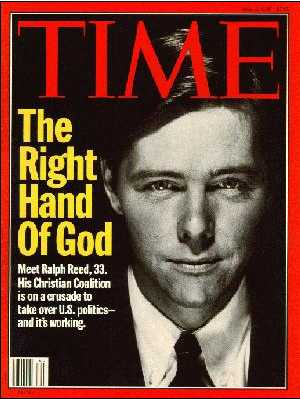
Both educated and articulate, the man Time magazine once called “The Right Hand of God” is an extremely gifted public speaker who exudes knowledge and is conversant on almost any issue. Reed backs up his talk with what he calls "the most comprehensive agenda of any Lt. Governor candidate." He has over 40 pages of issues-related material on his website, which covers every foreseeable topic he could possibly have a chance to impact during his prospective term as Lt. Governor, and he repeatedly reiterates his status as the "first candidate in this race" to address many of them.
His "Grow Georgia" plan includes lowering the state income tax (which, he loves to point out, is "higher than 'Taxachusetts'"), “eliminating the capital gains tax," and "promoting a "Taxpayer Dividend Act" which, after allowing for annual population growth and inflation, [would] dedicate ¼ of any budget surplus to education and ¼ to bonds (to maintain Georgia's AAA bond rating), and [would] return the rest to the taxpayers," as "money belongs to the citizens" and, as shown in the 1980s and the 2000s, "economic growth is spurred by lower tax rates."
Reed also supports a constitutional amendment to protect private property rights, maintaining that it is "very important to oppose eminent domain abuse," as the three "foundational human freedoms are life, liberty, and the right to own property," and "true freedom includes the right to control and own property." On the topic of immigration, Reed is strongly opposed "amnesty in all forms," and cites the need to "protect the borders." He supports the state’s recently enacted Voter ID law, and is in favor of a “comprehensive audit of the current voting rolls.” On family-values issues, he continues to reiterate his strong pro-life stance.
Reed favors a HOPE scholarship amendment to “protect funding” for Georgia’s unique merit-based college scholarship program, and to “make home-schoolers eligible for immediate benefit." He has also proposed a program called "Charters for Choice", which would determine failing schools (low test scores for three straight years, a graduation rate of under 50%, and other determinants), and would provide scholarships for students from these schools to go to private or religious schools, be home schooled, or transfer to a public school of their choice.
A proponent of joint-enrollment and vocational training, Reed calls a good education a "basic civil right," and cites a Harvard study which showed that school choice and competition is "more effective in raising test scores and improving schools" than the fixes instituted by Ted Kennedy’s No Child Left Behind Act. “When two professors from Harvard agree on the effectiveness of school competition,” he loves to say, “That’s what I call consensus.”
Unfortunately for both candidates, consensus among Georgia’s Republicans is hard to come by in this race. Supporters are quick to flaunt their opponent’s weaknesses, and Reed’s background, though providing him with a network of national contacts whose aid he could potentially enlist to help enact his agenda as Lt. Governor, makes him a polarizing figure. Cagle harps on Reed’s lack of legislative experience (though Reed generally refrains from personally attacking Cagle), and anti-Reed bloggers have jumped all over his decision to make his first run for office “in the same cycle that he is a figure in the biggest scandal to hit Washington in the past decade,” saying that it “hurts the party.” This is backed by a recent Matt Towery poll, which shows Reed 7 points ahead of Cagle, but also has him as an 8 point drag on the GOP ticket this fall.
A Reed campaign worker pointed out that the Abramoff casino gaming situation, which Reed calls “an attempt by the liberal media and others to engage in guilt by association,” was “nothing to worry about,” as Abramoff has already been tried and sentenced, so “if there were any truth to the allegations, something would have happened by now, and Georgia’s voters know that.” Still, the campaign is worried enough about the situation that Reed feels the need to address it at the end of almost every speech, saying “if I had known then what I know now, I never would have” worked with Abramoff, but always pointing out that his part in the affair “helped protect countless families from the dangers of online gambling.”
Regardless of the lack of anything more substantial than spoken allegations against Reed, the situation has provided fodder for Democrat and pro-Cagle bloggers, who repeatedly point out that he is “the only candidate [in this race] who has a criminal defense attorney.” This has not stopped big-name Republicans Rudy Giuliani and Newt Gingrich from helping him in this election, though, as both have appeared at Reed fundraisers this year. Several other national figures are also solidly behind Reed’s candidacy.
This contest, which pits two very different candidates with impressive resumes against each other for their party’s nomination, is inarguably the most contentious battle in Georgia this year, dividing the GOP across the state. Appearing at a March fundraising event for the Georgia GOP and the Perdue campaign, President Bush refused to inject himself into the race, saying only that there are “two candidates running for lieutenant governor, Casey Cagle and Ralph Reed, [and] we appreciate them both being here tonight.”
The race is a statistical dead heat, and who will emerge from the July 18 primary as the party’s nominee is anybody’s guess. Both campaigns tout polls which show their candidate in the lead, and the tone of the race will most likely grow more negative over the next two months. What is inarguable, though, is that both of these candidates have a clearly articulated vision for a better Georgia, and for their role in making that happen. The greatest worry among Georgia’s Republicans must be that the primary will take such a toll on the winner that he will be irreparably damaged heading into what promises to be an extremely tough general election.
Jeff Emanuel, a Special Operations military veteran, studies Classics at the University of Georgia. He is also a contributing editor for conservative web log RedState.com, and is a columnist for the Athens, GA Banner-Herald newspaper.
Copyright © 2006 Townhall.com
Labels: Georgia, Primaries, Republicans, Scandals
Permalink |
|
Making a move on illegal immigration
By Jeff EmanuelMar 26, 2006
The "most comprehensive illegal immigration proposal ever to come before the Georgia Legislature" made it out of the Georgia state Senate this month when it was approved by a 40-13 vote of the 56-member body. Supporters hope that other states will follow Georgia’s lead and that this legislation could be the beginning of an immigration-reform movement across the nation. The House is expected to pass the bill and Governor Sonny Perdue will likely sign it into law, but the all-inclusive measure is sure to spark a major courtroom showdown in the near future. Senate Bill 529, known as the "Georgia Security and Immigration Compliance Act" is a much-needed response to the ever-increasing number of illegal immigrants in Georgia who benefit from the state's taxpayer-supported programs while avoiding paying into the system.
Nobody seems to be able to make an accurate estimate; the number is often listed as "between 250,000 and 800,000"—a margin of error which is so large that it provides an excellent illustration of the problem itself. A population can only support so many non-productive beneficiaries of goods and services, and the swelling underclass of illegal immigrants is straining Georgia’s state infrastructure to a point at which further inaction would be extremely detrimental to the state’s economy and society.
"If this bill in its present form makes it into law, it will be the strongest [state immigration] law in America," said state Sen. Chip Rogers (R-Woodstock), one of the bill's sponsors. SB 529, which was a no-brainer to pass in an election year when almost 80% of Georgians want this issue addressed, would "prohibit adult illegal immigrants from receiving many taxpayer-funded benefits, financially penalize private employers who hire illegals, require employers with public contracts to verify that their workers are in the country legally, and crack down on human trafficking." It would not, however, "prohibit the children of illegal immigrants from attending public school, nor would it deny them certain medical benefits, such as emergency medical care, prenatal care and immunizations"—benefits which have already been largely guaranteed by federal courts.
This measure’s passage has sparked controversy among student groups on the state’s more liberal university campuses. Various pro-illegal immigration groups have protested the measure, calling the legislation "troubling" and citing in large part the revocation of illegals’ current ability (which they often refer to as a "right") to pay in-state tuition rates at state universities (a difference of roughly $12,000 per year). "If you cut that, there’s no way they can go to school," said a Hispanic Student Association spokesman, who added the dire warning that "educational barriers will only create a negative economic cycle among the illegal immigrants."
Threats regarding the enforcement of our nation’s laws resulting in a cycle of economic depression aside, this legislation is, for the most part, a very positive step forward on the road to getting Georgia’s, and America’s, ballooning illegal immigration problem under control. The Compliance Act does not advocate deportation or other "inhuman" treatment of illegals, but rather encourages those who are here to make themselves known and to comply with the law, while discouraging those who are elsewhere from migrating to the state of Georgia in hopes of gaining an under-the-radar, illegally "free ride" through the state’s institutions and services—many of which are barely efficient enough to cater to legal, tax-paying citizens. Undocumented "students," for example, are by law illegal; therefore, it makes perfect sense to not guarantee them privileges like in-state tuition, which are reserved for citizens of the state.
The price America pays for being the strongest, most prosperous, and most free nation on earth is that people the world over are constantly striving to immigrate here. A microcosm of that is that many of those people attempt to accelerate their relocation here by doing so outside of the law. We as American conservatives, who pride ourselves on living in a "nation of laws," must take care to differentiate between those in this country who are law-abiding citizens and legal immigrants, and those whose presence is a violation of law.
There will always be a demand for low-wage, high-efficiency, unskilled labor, which immigrants today so readily provide. As President Bush said this week, if an "American won't do a job and you can find somebody who will do the job, they ought to be allowed to do it legally." While we American conservatives are, and should be, 100% for immigration, we are, and must be, 100% for the law as well. This has always been a nation of immigrants; our history as a "melting pot" is a large part of what has made us the great nation we are today. However, even more importantly in this modern age of terrorism than ever before, it cannot—and must not—be too much to ask that those who come to this country, be it for the lifestyle, the opportunities, the freedom, or the work, do so legally, and with a full disclosure of their intentions.
Jeff Emanuel, a Special Operations military veteran, is a columnist and a director of conservative web log RedState.com.
Copyright © 2006 Townhall.com
Labels: Georgia, Immigration
Permalink |
|
Georgia's HOPE chest
By Jeff Emanuel
Mar 14, 2006
With just two weeks left in the Spring 2006 legislative session, time is running out on a proposed constitutional amendment which would ensure that Georgia’s unique merit-based college scholarship program will remain funded beyond the foreseeable future.The brainchild of then-Governor Zell Miller, Georgia’s “Helping Outstanding Pupils Educationally,” or HOPE, scholarship program rewards students who graduate from a Georgia high school with at least a 3.0 grade point average by providing them a tuition-free education at a Georgia state college, university, or technical college. Students must maintain a B average in college to keep the HOPE benefit, with grades being re-evaluated every 30 attempted academic hours to ensure eligibility. Since the program’s inception in 1993, more than 900,000 students have received benefits, which also include student fee coverage and a textbook allowance.
Miller proposed that this merit-based scholarship be funded by a new state lottery, whose profits were to be used solely for that purpose. Georgia’s location in America’s “Bible belt” ensured that such a morally appealing carrot was necessary to make the inception of a state lottery palatable to the general public. After much public debate, the voters accepted both programs, but a major reason for the lottery’s approval was the promise of its revenue being used only for higher education and pre-kindergarten programs. The dedication of lottery funds to the HOPE scholarship lasted all the way until the program ran a surplus, at which time Democrats in the state assembly expanded lottery proceed-eligible projects to include technological upgrades in public schools and related training for teachers, as well as other, less-defined “hometown projects.”
This expansion may seem beneficial on the surface, but, as is true everywhere, Georgia lawmakers have fought to take ever-increasing amounts of these benefits home to their individual districts as vote-buying pork projects. $1.8 billion in lottery proceeds have now been spent on projects other than HOPE scholarships and pre-kindergarten classes, and lawmakers have been forced to begin talking about cutting the program’s budget. College enrollment has risen almost 10 percent in Georgia since HOPE’s inception; however, the combination of that increase in attendance, the fact that many already in college qualify for the program, and the increase in pork spending have created an incredible financial strain. In 2004, a panel studying the program’s future recommended that Governor Perdue cut book and fee payments to scholarship students, and more cuts are inevitable if the program’s funding situation remains unchanged.
In an effort to safeguard the HOPE scholarship for the future, and to guarantee that it remains funded to the fullest extent possible, Georgia Governor Sonny Perdue recently proposed what he called the “HOPE Chest” amendment. This measure would go a long way in securing this unique merit-based scholarship program by amending Georgia’s state constitution to “protect lottery funds so that they may be reserved only for the HOPE Scholarship Program and other tuition grants, scholarships, or loans to enable citizens of this state to attend colleges and universities within this state; for voluntary pre-kindergarten; and for educational shortfall reserves.”
SR 655, currently in the Georgia state Senate, would put the HOPE Chest amendment on the statewide ballot in November, allowing Georgia’s voters to decide for themselves whether or not they want to guarantee further their children’s affordable academic futures. However, this attempt to give citizens a say in the governing process has been met with fierce partisan resistance. The measure has twice been voted down in 35-20, party-line votes, falling just three votes short of the two-thirds majority needed in the 56-member body to amend the state constitution. One final vote on the measure may be held, but Democrats, who claimed they were "shut out of the process" and had a "better plan" which was "being rejected for political purposes," are not expected to change their minds.
The promise of HOPE has encouraged students to excel at both the secondary and the university level. However, the decision of Democrats to play the role of the opposition, even when it comes to safeguarding a vital educational benefit, and to attempt to kill this proposed amendment in favor of securing lottery funds for pet projects, will only plunge the program into greater crisis. Without some Democrats finding the courage necessary to cross the aisle and do what is right for the educational future of the Georgia’s children, the state’s model program for merit-based scholarship, which has served as the inspiration for many similar elsewhere, will almost certainly wither on the vine.
Jeff Emanuel, a Special Operations military veteran, studies Classics at the University of Georgia. He is also a contributing editor for conservative web log RedState.com, and is a columnist for the Athens, GA Banner-Herald newspaper.
Labels: Academia, Georgia, Policy
Permalink |
|