From Iraq: Underscoring the Danger

* * *
Bidding farewell to a man who was there for all the right reasons.
 I met Dmitry Chebotayev while in the Green Zone in Baghdad. He was between embed assignments (having come from a component of the same unit I was about to embed with), and I was waiting to head out to the field. The group of us there at the Combined Press Information Center (CPIC) spent the whole day talking about journalism, Iraq, and journalism in Iraq - a fascinating, multinational conversation. I remember Dmitry very well; he was young (about my age), motivated, and exceptionally smart and talented, and in that one day we spent together he made an eternal impression on me.
Like many of the foreign journalists I spoke with, he was impressed by the soldiers he met, and very much wanted to get the story right the first time, rather than wanting to make news or frame a narrative himself.
Along with being a great, personable, nice young man, he was very, very good at what he did, and it was literally gut-wrenching to me to hear of his death this past week. Though I could go on for some time about how highly I thought of Dmitry, though, the praise which deserves to be published here is that of the soldiers with whom he sweated and suffered - and, ultimately, died.
This is what Major Kirk Luedeke, the Public Affairs Officer for the 1st Infantry Brigade Combat Team (IBCT) of the 1st Infantry Division (the parent Brigade of the 1-4 Cav, among others), wrote to me after Dmitry's death:
We...lost a dear friend - embedded photographer Dmitry Chebotaev of Russian Newsweek, who had spent a week with the 2-12 IN in Doura before going to Baqubah. He was the European journalist killed along with 6 U.S. heroes in a Stryker on Sunday. He was young, energetic, smart and fair. Like you, he wanted to be with the Soldiers and share in the hardships and dangers. And like you, the Soldiers respected him and were genuinely shaken upon hearing the news of his death.Emphasis added. The dangers in Iraq are very real, for journalists as well as for soldiers. 69 reporters were killed last year alone in Iraq, and nearly 200 have died overall since the war began in 2003.
It really underscores the dangers that we all face here in Iraq, no matter what our mission is.
However, to simply make Dmitry a statistic would be to do him a disservice. He, like the rest of us who volunteer to go to Iraq as journalists, knew exactly what the dangers were, and embraced them with a full awareness of the possible outcome of his actions. Dmitry was an example to all of us who aspire to something bigger than ourselves, and in demonstrating the risk which must be taken in order to do just service to that bigger ideal, he made the ultimate sacrifice, alongside the soldiers he loved, respected, and was there to report on.
I tip my cap to a man with such conviction that he would inject himself into such a politically charged and life-threatening situation simply to observe and relate the truth to his readers, and only hope that my modest endeavors in such a pursuit can reflect positively on his legacy, and live up even in part to the example and high bar he set.
Requiescat in Pace, Dmitry - you were taken from us far too soon, and you will be missed dearly.
Labels: Blog, Live from Iraq, Media
Permalink |
|


From Iraq: The Iraqi People, Front and Center

American troops don't want to abandon the Iraqi people.
The debate about the war in Iraq often focuses on America’s national security, other countries’ opinions of the US, “what is best for the troops,” and, of course, the Bush administration. Only on the rarest of occasions is lip service paid to those who will feel the effects of our decisions on the war most immediately, most acutely, and for the longest time – the Iraqi people. At the end of the day, Americans can simply click off their television sets and forget about the situation in Iraq. For the families living there, that’s just not possible. They have to live forever with the consequences of our actions.As Lt. Colonel James Crider, Squadron commander of the 1-4 Cavalry (“Quarter Cav”), told me, “I’ve had several Iraqis tell me that...[t]hey want us here - not forever, but for now, until they can take care of themselves.”
“'It would be a disaster if you leave now,' they tell me.”
“At the end of the day, Americans can simply click off their TV sets and forget about the situation in Iraq. For the families living there, that’s just not possible.”
The national government of Iraq is struggling against the ingrained mindset of the Iraqi people to think of themselves as members of tribes, sects, neighborhoods, and clans, rather than as members of a unified nation. “Saddam kept the country together,” an Iraqi expatriate, who fled in the 1990s and returned this year as a contractor, told me. “It hurts me to say this, but what we need is the American army to completely take over the government. The people are not ready for freedom yet; you took away the one thing that had held the country together without anything to replace him. That was a very big mistake.”
An Army Specialist agreed, saying, “I don’t know if we can win [this war] in the sense of leaving a perfect democracy here or an ideal situation in that sense -- my feeling is sometimes that it might take another dictator, because the people here still don’t understand freedom the same way we do. Also, they don’t think of themselves as a nation -- they think in terms of religion, sect, and tribe. They follow their local or religious leaders. A dictator is what it took before to hold the place together as one country, and might again.”
The American government is not helping, as it is playing its all-too-public political games. Though he may have thought of it as just being between him and his “friends” in the mainstream media and the fringe “Daily Kos” left, Senate Majority Leader Harry Reid’s (D-Nev.) comment that “the war is lost” and “the surge…hasn’t accomplished anything” was splashed on the front page of every news outlet from Al Jazeera to the Iranian state newspaper. Contrary to the beliefs of all too many Americans who seem tied to the notion that the Iraqi people are both blind and ignorant, Congress’s votes to set a withdrawal date from Iraq -- much like their other, similar votes and statements -- were heard with perfect clarity by Iraqis, as well as by the insurgents who take heart from them. These statements encourage Iran to increase its involvement, as well, as they are seeing an increasing political return on their deadly investment in this war. (A Colonel within the MNF-I political apparatus told me that “if you take [Iran] out of the equation…we could probably reduce our casualties almost in half.”)
“I had people coming up to me as we patrolled the neighborhoods saying, ‘We heard you were leaving,’ an officer with Quarter Cav told me. “They don’t understand our process; they don’t know that this is just rhetoric, or that it will be vetoed. All they know is that the leaders of our Congress said that it’s a lost cause, and that our government has voted to pick up and go home.”
Such statements by America’s political leaders are “terrible,” an Army public affairs soldier told me. She continued, “I understand political posturing …but it really is terrible. If the war is lost and we need to go home, then why do we need to stay here five more months, when I could die or my friends could die” for a lost cause? “The war is either over or it isn’t; this just doesn’t make sense.
“What we want is to keep helping the people here. The people at home who say these things, they don’t understand that these are people who have to live here after we leave, whatever the situation is. These people and the things that happen here aren’t real to them, and they can’t understand unless they’ve been here and seen it.”
Like many Americans at home, there are several soldiers who would like nothing more than to see the US end its involvement with Iraq as soon as possible. There are also many, though, who, having established a presence on the ground, and having spent time among the people of Iraq, want to see this mission through to a successful conclusion, not only for America’s sake, but for the sake of the people of Iraq whom they have gotten to know during their time in country.
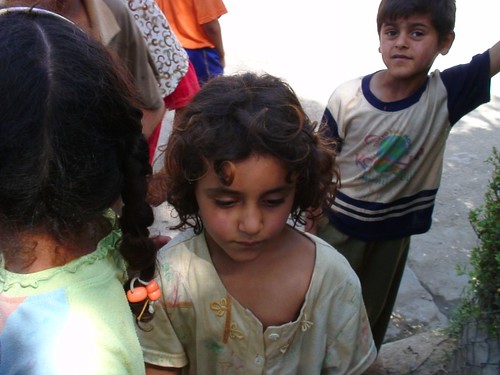 Our young combat leaders understand -- better than senior political leaders at home -- how we hold the lives of Iraqis in our hands. One example is a bespectacled captain of infantry I spoke with , who was on his second tour in Iraq and had been there since just before Gen. Petraeus’s confirmation as the new head of MNF-I.
I asked what he thought about the mission in Iraq, and what he thought the prospects for success were. Gazing pensively at the ground, he took a moment to collect his thoughts, and said, “Well, politically, staying here probably isn’t the best decision.” Given the situation at home, he added, “winning here seems less possible all the time, even though we’re now doing what it is we probably should have been doing all along.” Recovering from that moment of near despair, he paused and glanced up, and, looking earnestly at me through his thick, military-issue glasses, he said, “There’s not a single one of my soldiers who doesn’t look at the neighborhood we’re in, look at the children there, and not want to do whatever they can to give these kids as bright a future as possible. We want to finish this job, and we know we can do it.”
The Iraqi people themselves, though, are also an obstacle to their own success. “What has to happen here,” one noncommissioned officer told me, “is that the Iraqi people have to take a chance, risk their lives, and stand up against al-Qaeda and everybody else. Once they decide that they want freedom and peace, and want to work with us, then it will all be over.”
“It’s easy to live as a coward. If they want to be free, they will have to take the risk.”
What the Iraqi people need more than anything else to push them toward making that decision is a consistent, unified message, both from America and from their government, that as long as they are willing to work for their own freedom and self-sufficiency, they will be supported with whatever it takes, and with no threats of precipitous withdrawal and abandonment -- an act which would leave them at the mercy of an unspeakably brutal insurgency.
What many of the troops, and many of the Iraqi people, both want and need is to be given the support and the resources which will allow them to establish a free and secure state which can endure without an overt American presence. More than anything else, they need the time to succeed.
The last time we asked the Iraqi people to stand up to oppression and barbarism was after the 1991 Gulf War when we encouraged revolt against Saddam. They did, and we failed to come to their aid. We have asked much more of them in this war. This time, we must be faithful to them, and to ourselves.
Mr. Emanuel, a special operations military veteran, is a columnist and a Director of conservative weblog RedState.com.
Labels: Live from Iraq
Permalink |
|
From Iraq: Iraq the Model?
Winning Hearts and Minds in Abu Dischir
Note: For better size and resolution of all photos, flip through this online album.
On the morning of May 1, I accompanied the second platoon of 1-4 Cav’s Alpha (“Apache”) Company and members of the sherda, or Iraqi National Police (NPs) on a joint patrol of the southwestern quadrant of the unit’s area of operations, in the area known as Abu Dischir. The main purpose of the patrol, and the house searches it entailed, was to continue showing a sustained US presence in this Shi’a district which is home to large numbers of Jaish al Mahdi, or "JAM" members, and to check for such things as weapons caches and unlicensed firearms (each Iraqi household is allowed a registered AK-47 and thirty rounds, but no other weapons). Upon arriving, I was amazed at how drastically different Abu Dischir was from the Sunni neighborhood to its north, al Hadir, where I had been only days before, and which has been suffering under the dual blights of an influx of al Qaeda and of Shi'a death squads. Instead of trash being piled literally feet high on the streets, the ground in the district was relatively clean. The homes were largely in good repair, with very few abandoned houses. There was almost no gunfire to be heard – a stark contrast with al Hadir, where AK-47 fire can be heard almost around the clock. The air was one of hope, not of despair, as it had been only a few blocks to the north. “Nothing’s going to happen to you here,” said Sergeant First Class Edgy, the unit’s platoon sergeant. “It’s a pretty calm place.”
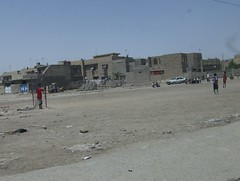
It was an amazingly calm place, but even more amazing to me was the presence on the streets. People were everywhere; shopping at the market, talking with their neighbors, and walking from place to place with so little overt concern for their safety that they might have been living in Atlanta instead of in Baghdad. Teenagers were playing soccer on a dirt field at the end of the block (photos: 1 | 2 | 3 | 4), and as we drove by houses children came running up to the trucks asking for chocolate and for footballs (photos: 1 | 2 | 3 | 4 | 5).
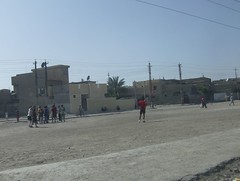
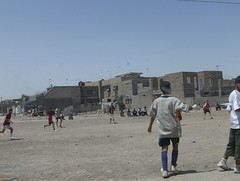
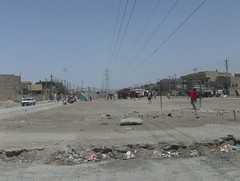

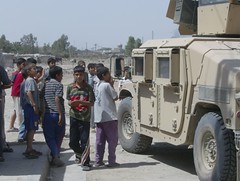
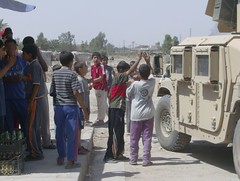
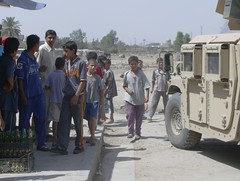
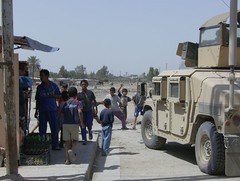
 As soon as we dismounted from the vehicles, I was mobbed by young people who wanted to shake my hand and to ask for my camera. “Meesta! Meesta!” they would call over and over again to get our attention, always wanting to show us something, or to ask for anything that we had. One soldier was asked for his weapon (he politely refused), and after several requests for my camera had been rebuffed, one enterprising young man of twelve or so approached me with something in his hand, which turned out to be three shiny new quarters. “You see this, meesta?” he said. “It’s money!” I acknowledged that it was indeed money – seventy-five whole cents’ worth – and again politely declined his kind offer of such a generous sum in exchange for my camera.
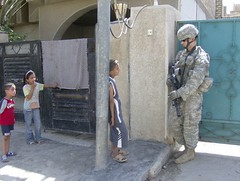
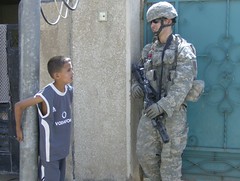

As we patrolled through the neighborhood, we were continuously besieged by kids who followed us from block to block, crowding so closely around us that, had there been an adult in the area who wished to harm us, he would literally have had to fire through a wall of children. Though this became a bit tiresome after a few hours, I have to admit that the Iraqi children in that neighborhood were absolutely adorable, and that they were nothing if not extremely friendly. At one point, thirteen or so had crowded around myself and Private First Class Siverd, who was pulling security outside of a house which was being searched, and when I turned toward them with my camera, what had been a gaggle suddenly formed itself into a group posing together for a photograph (photos: 1 | 2 | 3).
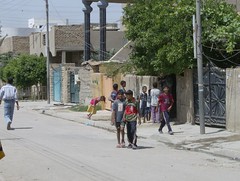
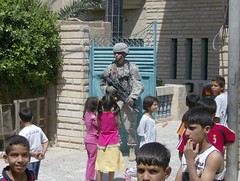
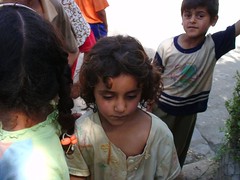
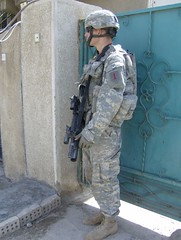
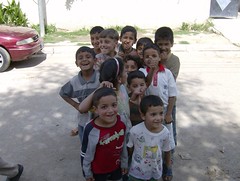
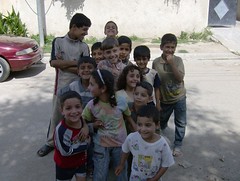

 The young adults looked, as young adults often tend to, a bit scruffy and sardonic, wearing their warm-up suits (rumored to be the unofficial uniform of JAM in the area) and keeping a watchful yet mocking eye on us from a safe distance. The adults themselves, though, were nothing if not gracious and hospitable, smiling and waving, saying hello, and welcoming us into their homes if we wanted to search them, and even smiling and posing for photographs in the courtyard while soldiers looked over their homes. Their cooperation went a long way toward keeping the operation very brief and low-key; as I have mentioned before, the people of Dischir seem, by and large, to have bought into the fact that their cooperation will be repaid by kinder, gentler, and shorter American activities in their neighborhoods, and a better overall living situation.
The closest thing to a conflict which we observed was the emotional request from a neighborhood inhabitant for America to repair his house, damaged by a mortar. The man grew more frustrated as his request was not met, and adults from up and down the street gathered around him, Lt. Sisoura (leader of Alpha troop’s second platoon), and the army’s interpreter, known as “Neo” (middle, center left, and center right, respectively, in this photo). After nearly half an hour of heated discussion, the group broke up, and Lt. Sisoura told them all to return to their homes. As he walked over to me, I asked him what had happened. "He wants his house fixed," the Lieutenant said. I responded to this with the obvious question, asking whether he had agreed. "No," he said. "We didn't do it. We can't fix everybody's problems, especially when we didn't have anything to do with it in the first place."
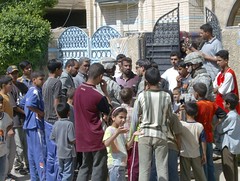
 Trying to "fix everybody's problems" is a futile task in Iraq, as well as elsewhere in the world. However, attempting to provide both infrastructure and security for the Iraqi people is an absolutely necessary undertaking in this effort. A large part of the US’s recent mission has been to “win hearts and minds,” which is accomplished by convincing the Iraqis not only that coexistence with US forces is superior to fighting against them, but also that the coalition can provide for them a quality of life that the sectarians and insurgents they are currently putting up with in their areas cannot. While this can work – and is working – in many areas (such as Anbar Province), those controlled by JAM are another matter altogether. Their quality of life – from the cleanliness of their streets (no small issue in Baghdad, large parts of which appear to be one giant rubbish heap), to the safety of their neighborhoods – is assured by the JAM living there. This is further enforced by the fact that many of the NPs, already majority Shi’a, are affiliated with JAM; some even cover their faces – illegally – when on joint patrols in the district, so as not to upset other Sadrist hardliners who might not look kindly upon their cooperating so completely with coalition forces.
Given this, the US cannot easily convince the people of such districts to break with JAM in hopes of receiving even better quality of life at the hands of the coalition; instead, as an intelligence officer told me, “we have to convince them that life in cooperation with us as well as in cooperation with the JAM can be even better than what the JAM provides alone.” The people of Abu Dischir appear to have reached almost that conclusion themselves, to the benefit both of them and of US forces working in the area: that not actively working against the coalition will have a better effect on their well-being than doing so, and because of this, they are able to love in a relatively clean area, which has relatively little violence, in which the people can live and American troops can move in relative safety.
While Anbar can serve as a model for the pacification and reconstruction of provincial Iraq, Abu Dischir has the potential to serve as a model of sorts for parts of Baghdad which are still struggling to reconcile their sectarian affiliations with a desire for a good life. It is not perfect, of course; rumor has it that that Sadrist hardliners who have more desire for violence than the regular inhabitants of the neighborhood have been showing up from elsewhere in Iraq, which could hurt the area’s stability in the near future. However, having gained a foothold in southwestern Baghdad, the coalition can now use the example of this neighborhood to show the rest of the country that the coalition and reconcilable followers of Muqtada al Sadr can in fact coexist, for the benefit of the Iraqi people themselves.
For the rest of Jeff's embedded reports, click here. To learn more about embedded reporting from Iraq, and what you can do to help make it happen, click here.
Labels: Live from Iraq
Permalink |
|
From Iraq: Back from the Front

Back from Iraq
Fifty-plus insurgent and sectarian cells exist in Quarter Cav’s area of operations, and the unit has done very good work against them to this point. But given the ongoing incursion of AQI and JAM hardliners in the area, a very large flashpoint between these two western neighborhoods exists, and could be ignited at virtually any time. If and when that happens, the only question in Rashid – as it currently is in some other areas of Iraq – may be whether to put our soldiers in the middle of the fight to protect the civilians who are growing to trust, or to let these two sects, both of which are capable of extreme violence and brutality, wage war on each other in hopes that one or both will be fatally wounded.
The troops’ opinions on this situation, as well as on the war as a whole, are as varied as those of Americans at home. Views range from overt pessimism to a sincere desire to help the Iraqi people have a better life than before. “There’s not a single one of my soldiers,” an infantry captain told me, “who doesn’t look at the neighborhood we’re in, look at the children there, and not want to do whatever they can to give these kids as bright a future as possible. We want to finish this job, and we know we can do it.” Spending time in Iraqi neighborhoods with the Quarter Cav, I had a chance to be around many Iraqi families, both Shi’a and Sunni, and I saw firsthand how happy they were to see American soldiers on their streets, and to welcome them into their homes.
The American military is doing amazing work in many different areas in
I arrived in
That is happening in
Both the soldiers and the Iraqis have spoken loud and clear: the political games must stop. A commitment must be made, either to victory or to withdrawal, and both sides will have to live with the consequences if the wrong choice is made. At the end of the day, Americans can, in the short term, simply click off their television sets and forget about the situation in
Mr. Emanuel, a special operations military veteran, is a leadership fellow with the Center for International Trade and Security at the University of Georgia, where he also studies Classics. In addition, he is a Director of conservative weblog RedState.com, and is a columnist for the Athens, GA Banner-Herald newspaper.


Labels: Live from Iraq
Permalink |
|
From Iraq: A Tale of Two Boroughs

With the 1-4 CAV: On patrol with a modern-day "Band of Brothers" on the streets of Baghdad
On my trip to Iraq, I embedded with the 1st Squadron of the 1st Infantry Division’s 4th US Cavalry Regiment (based out of Fort Riley, Kansas). The 1-4 Cav (“Quarter Cav”), a brand new unit, was created in January of 2006, and arrived in Iraq for this, its first combat tour, in February of 2007. It contains a disproportionately high number of soldiers (officer and enlisted) who are on their first combat tour of any kind and, though they seem like seasoned professionals at this point, Privates with fewer than eighteen months in the Army abound in the unit’s platoons which are operating on the front lines in Baghdad."We are really like the 'Band of Brothers' in some ways," the 1st Brigade Combat Team's Public Affairs Officer (PAO), Major Kirk Luedeke, told me.
Just like the guys from the 101st Airborne Division depicted in [the miniseries], we are learning on the fly in the crucible of combat, and many of our team leaders and squad leaders haven't ever done this kind of thing before. But they're learning quickly and using sound judgment and leadership techniques each day. They're team leaders and squad leaders because their chain of command has recognized their potential and given them responsibilities that would normally have gone to guys with more time and deployment experience. The way we were constituted as a new brigade did not afford us the luxury of having a large percentage of experienced junior enlisted and NCOs, so we are a modern day 'Band Of Brothers' in that regard.
The squadron’s inexperienced nature has caused it to endure some rough patches while learning “on the fly” – especially from its mistakes. More rough times doubtless lie ahead, both as a result of this rawness and of the fact that, rather than being assigned to a single area of operations for the duration of its tour (a situation which would make sense, given that sustained presence is a key point in the Army’s counterinsurgency doctrine personally authored by MNF-I commander General Petraeus), the unit will soon be assigned to its fourth separate AO in three-plus months, having its cavalry, reconnaissance, and light infantry capabilities replaced in the current area by lumbering Striker vehicles from the 2nd Infantry Division in Fort Lewis, and moving north into Dora proper to provide some much-needed help in that area. However, this is not to belittle the 1-4 Cav’s many successes, or the fact that its soldiers are quickly proving to be both capable warriors and fast learners.
The Quarter Cav’s current area of operations in Iraq is home to a diverse population. Working in East Rashid, a district in southwestern Baghdad and a part of the Dora quarter of the city, the 1-4 oversees an area which includes Sunni, Shi’a, and Christians, with a good portion of its eastern neighborhoods being mixtures of at least two of the three. The western portion of the district, though, is clearly defined along sectarian lines, with the area known as al Hadir, lying north of a street called “Yemama Road,” being predominantly Sunni, and the area south of the road, called Abu Dischir, being almost exclusively Shi’a, and heavily populated by members of the “Mahdi Army” (the Jaish al Mahdi, or JAM) – followers of Muqtada al Sadr.
Al Sadr and his followers have, of course, been in US headlines since 2004. The violently anti-coalition Shi’a cleric has sought for years to undermine US efforts in Iraq, both by fomenting violence against coalition troops and by refusing to cooperate in the efforts to govern Iraq effectively. His more recent public statements urging his followers not to cooperate with the coalition have hindered what was a bourgeoning coexistence between US troops and some areas heavily populated with JAM like Dischir. Despite this, and despite the fact that the Sadrists remain one of the most violently anti-coalition Shi’a sects, the Abu Dischir district appears to be an example of a fairly positive coexistence between US forces and the people in a JAM-heavy area.
Areas such as Dischir and other JAM-influenced districts are a difficult case for the coalition to deal with. A large part of the US’s recent mission has been to “win the hearts and minds,” so to speak, of the Iraqi people. This is not necessarily accomplished by trying to remake the Iraqis into flag-waving America lovers so much as it is by trying to get the Iraqis to accept not only that coexistence with US forces is superior to fighting against them, but also that the coalition can provide for them a quality of life that the sectarians and insurgents they are currently putting up with in their areas cannot. While this can work – and is working – in many areas (such as Anbar province), those controlled by JAM are another matter altogether. Their quality of life – from the cleanliness of their streets (no small issue in Baghdad, large parts of which appear to be one giant rubbish heap), to the safety of their neighborhoods – is assured by the JAM living there, and further enforced by the fact that many of the NPs, already majority Shi’a, are affiliated with JAM (though some cover their faces – illegally – when on joint patrols in the district, so as not to upset other Sadrists who might not look kindly upon their cooperating so completely with coalition forces).
Unlike many sectors in Iraq and in Baghdad, the people of Abu Dischir appear not only to have realized, at this point, that choosing not to fight Coalition forces results in Coalition forces not fighting them, but, more importantly, they appear to be acting on that realization. As a result, Coalition and joint patrols there are much more relaxed than elsewhere. While I was there, I felt almost uncomfortably safe, as I was mobbed by children asking for chocolate, for their picture to be taken, or for my camera. The neighborhoods seem happy, and the people appear to be living their lives in the best way that they can. Rather than sprinting from house to house, keeping as covered and concealed as possible (as is the case in al Hadir), the soldiers move calmly and almost casually through the streets. Though they are always prepared for the situation to change, the soldiers' ease of manner and movement belies a surprising sense of security while in the Sadrist district. "Nothing's going to happen to you here," said Sergeant First Class Edgy, the platoon sergeant for the second platoon of Quarter Cav's Alpha Troop. "It's a pretty calm place." Calm is, of course, a relative term, especially for SFC Edgy, who was the only member of his crew to walk away from a massive IED blast three weeks ago that killed his Humvee's driver and seriously injured his medic and gunner.
North of "Yemama Road," the dividing line between the two neighborhoods, is a different story altogether. Small arms fire echoes through the streets and alleys of the predominantly Sunni area of al Hadir almost constantly, and the 1-4 Cav lost their first soldier to a sniper in this area only a few weeks ago. The neighborhoods are largely deserted, with many houses having fallen into disrepair, and there is a tangible sense of despair among the people living amidst the ruins. The area is filthy, with piles of trash standing feet above the ground in the roads and on the sidewalks, creating ideal hiding spots for IEDs; while Iraqi companies have previously bid for the trash collection job there, a few shots fired by insurgents at the workers is enough to stop them from coming back.
The area has seen a high number of extrajudicial killings (EJK), with bodies being found regularly in abandoned houses when not simply dropped on street corners. The primary culprit for these EJKs, which are better described as cold-blooded murders, is thought to be Shias affiliated with the NPs--the primary weapon used in these killings, I was told, is a Glock 9mm pistol, the handgun issued to the National Police. The more grisly murders, though--and there have been some horribly mutilated corpses found in the area--are generally chalked up to al Qaeda in Iraq (AQI), which has become well known for its brutality. While the JAM in the south appear to have some vision for the future--namely an independent, secure, prominent Iraq, free of western interference, and which follows al Sadr's brand of radical Islam--the goal of AQI is very simple: to cause as much havoc, to create as much turmoil, and to kill as many people as possible. "There may be some reconcilables" in JAM and other sects, Quarter Cav's commanding officer, Lt. Colonel James Crider, told me, "but the bottom line [on AQI] is that these are very bad guys who want to create as much chaos as they can."
What the West simply doesn't seem to grasp, he said, is that these terrorists cannot be appeased or brought into the political process. "They'll kill all the Shia they can," he said, "and then they'll kill all of the less-radical Sunni. And then, when there is nobody else left to kill, they'll start killing each other." In other words, the actions of al Qaeda in Iraq and their counterparts in various cells and sects are not--as is argued by some--simply a result of the American actions; no amount of appeasement, of apology, or of attempted reconciliation will cause them to renounce their brutal ways.
A very telling incident took place just recently in East Rashid. During a ribbon cutting ceremony for a newly refurbished school, with children in their seats waiting to begin class, AQI descended on the building from all sides and began firing on the U.S. soldiers, despite the fact that children were in the area and directly in the line of fire. The young troops of the 1-4 Cav fought off the assault, and class was conducted despite the inauspicious start to the school year for the poor children within, but the episode itself was very instructive about AQI and its methods. Terrorizing, torturing, and killing are simply what these people do; they are rotten to the core, and the only recourse the civilized world has is to destroy them.
The people of al Hadir themselves seem happy to see American troops. When I was participating in a patrol in the area, we were welcomed into homes and greeted happily, and as the day wore on and our presence continued, more people emerged from their homes to watch us from the street. With the presence of U.S. troops, the people apparently feelt safe enough to come outside--an obvious rarity in al Hadir. "Of course they're happy to see us," an officer with the 2nd Infantry Division told me. "When there are American soldiers on the street and in their house, they know nobody is going to come in and kill them."
"It's not the people themselves who want to fight us," said a soldier in Quarter Cav's Charlie ("Comanche") Troop. "The AQI and other insurgents are moving south into the area and causing havoc." LTC Crider considers this to be a major factor in the surge in JAM membership and activity in his Squadron's area of operations, saying that, in his opinion, "JAM mainly formed and grew [in Abu Dischir] as a defense against AQI," rather than as a force to oppose the Coalition. The influx of more insurgents into al Hadir from the north, and the continued shooting south across the northern boundary of al Hadir from Dora proper, combine to create a dangerous situation both for Iraqi citizens and for American troops, who constantly take fire of one kind or another when working in the sector.
Much of the violence in the region also originates from the mosques in the area. Shia and Sunni sectarians have fought bitterly between their separate neighborhoods, and one street, which featured a Sunni mosque on one end of the block and a Shia mosque on the other, was termed the "death zone" by soldiers who observed the heavy fire being exchanged daily between the two. Several mosques in the area have been destroyed, all by insurgent fighters; despite the unfounded perception to the contrary, the Coalition is still restricted from entering mosques--let alone firing on them--even when the enemy is known to be shooting from within. "When we see or suspect that illegal activity is taking place within a mosque," the 2 ID officer told me, "we have to stop what we're doing and get permission from Division to have the NPs go into the mosque, while we pull security outside. The Sunni mosques, the Shias are eager to go in and grab whomever they can. The Shia mosques, they'll usually go in and out, claiming that nothing was there. Go figure." In the case of one Sunni mosque, soldiers told me, a tip was given to the NPs that a boy was being held hostage there by private security guards; when the police detained the guards for questioning--thus leaving the mosque unguarded--Shia sectarians promptly burned it to the ground. By the time the authorities realized that the boy's abduction was a hoax, the charred remains of the mosque had been razed to the ground, leaving nothing but flat earth where the building once stood.
More than fifty insurgent and sectarian cells exist in Quarter Cav's area of operations. Though progress has been made in the brief time that the 1-4 Cav has been working in East Rashid--and many of the soldiers say that it has been both significant and obvious--the situation there is as fluid as it is everywhere in Iraq. Given the ongoing incursion of AQI and JAM hardliners into the area, a very large flashpoint between these two western neighborhoods exists and could be ignited at virtually any time. If and when that happens, the only question in Rashid--as in some other areas of Iraq--may be whether to put our soldiers in the middle of the fight, or to let these two sects, both of which are capable of extreme violence and brutality, wage war on each other in hopes that one or both will be permanently eliminated.
The progress the 1-4 Cav has made with its persistent presence in the area, despite being severely undermanned, could well continue with the arrival of the 2nd Infantry Division's Stryker brigade, which will begin to relieve them in place in the near future. The sheer manpower (with the number of personnel they can dismount, while still maintaining fully crewed vehicles for movement, patrolling, and protection) that 2 ID will be capable of putting on the streets will be far greater than that which the 1-4 Cav has available. However, the replacement of Humvees and frequent foot patrols with impersonal armored monstrosities seems more of a step back than a step forward in the battle to win over the trust and allegiance of the civilians in these neighborhoods. That goal is more easily accomplished by actually spending time with the people, getting to know them, and building relationships with them than it is by rolling down the streets in giant, threatening vehicles. The security factor may be higher in Strykers than in humvees or on foot, but the Coalition runs a risk in these neighborhoods that the replacement of human faces in with faceless armored shells will destroy the carefully crafted image of American soldiers as potential friends and protectors.
There is much work to be done throughout the country, and throughout East Rashid; after all, just to the north of Abu Dischir is a neighborhood which is as troubled as Dischir is settled. However, this area in the southwestern district of East Rashid has the potential to serve as a model of sorts for parts of Baghdad that are still struggling to reconcile their sectarian affiliations with a desire for a peace and security. It is not perfect, of course; Army intelligence reports indicate that Sadrist hardliners have been relocating here from elsewhere in Iraq, which could hurt the area's stability in the near future. Having gained a foothold in southwestern Baghdad, though, the coalition can use the example of this neighborhood to show the rest of the country that peaceful coexistence can be achieved between the Coalition and reconcilable sectarians, and to convince the Iraqi people that there is a better life possible should they decide to stand up to those creating chaos in their country. The Quarter Cav is doing their part on both fronts, conducting combat operations and public works projects. What is needed now is for the Iraqi people in other neighborhoods to follow that example, and to decide that they have had enough of JAM, AQI, and the other insurgent and sectarian groups that are actively preventing them from achieving a better life.
Jeff Emanuel, a special operations military veteran who served in Iraq, is a leadership fellow with the Center for International Trade and Security at the University of Georgia. In addition, he is an associate director of RedState.com and a columnist for the Athens, GA Banner-Herald newspaper.
For the rest of Jeff's embedded reports, click here. To learn more about embedded reporting from Iraq, and what you can do to help make it happen, click here.
Labels: Live from Iraq
Permalink |
|
American soldiers: Winning over Journalists, one Heart, Mind, and Life at a Time

Operation Iraqi Freedom saw the advent of a practice that revolutionized modern war reporting: the embedding of journalists with frontline combat units in war. This practice gave the media, the American public and the world unprecedented access to the soldiers on the front lines, as well as to the war itself, through the filing of stories, photographs and video from the battlefront in real time, by reporters who were right there with the soldiers doing the fighting. "We were offered an irresistible opportunity: free transportation to the front line of the war, dramatic pictures, dramatic sounds, great quotes," said Tom Gjelten of National Public Radio. "Who can pass that up?"While the military also benefited from having an eager outlet for its stories and successes, the biggest result of the embedding process was the shift it caused in the relationship between the military and the media, which laid the groundwork for a fundamental change in the dynamics of war reporting. As Maj. Gen. Buford Blount of the Army's Third Infantry Division explained, "A level of trust developed between the soldier and the media that offered nearly unlimited access."
Despite the obvious benefits of embedded reportage, though, the practice has met with its share of (expected) criticism from members of the Fourth Estate. Beginning even before Operation Iraqi Freedom kicked off, media spokesmen and others--such as University of Texas professor Robert Jensen--expressed concern that "embedded reporters would inevitably become too sympathetic to the troops with whom they were traveling." Theories were put forth that this was a "primary motivation on the part of military planners in designing the embedded system in the first place," and that the U.S. government was simply taking the approach of "feed the media beast enough stories that cast U.S. troops in the best possible light and the job of managing the media message is all but taken care of."
The latter is, of course, an absurdly simplistic notion. Rather than simply sitting back and receiving dispatches and releases carefully crafted to "cast U.S. troops in the best possible light," embedded reporters, by the very nature of their task, see the troops with whom they are living, working, and experiencing danger at all times--the good, the bad, the heroic, the angry, the emotional and the rest of the entire human spectrum. The former, though, does ring true to a degree; the debate on that count, then, is whether or not that is actually a bad thing.

“Absolutely amazing,” said David Beriain, the reporter (and the only one who spoke English), of the young Cavalry troops. “In Spain, it’s embarrassing – our soldiers are ashamed to be in the army. These young men – and they seem so young! – are so proud of what they do, and do it so well, even though it is dangerous and they could very easily be killed.” Beriain explained that the company he had been embedded with had lost three men in the span of six days while he was there – one to a sniper and two to an Improvised Explosive Device (IED) which had blown an armored Humvee into the air and flipped it onto its roof. Despite this, he said, and despite some of the things which they might have said in the heat of the moment after seeing another comrade die, the soldiers’ resolve and morale was unshaken in the long term, and they remained committed to carrying out their mission to the best of their ability for the duration of their tour here.
It was in the process of performing that mission, of coping with the loss of loved ones, and of just being themselves as American soldiers, that these young men were able to win over the admiration and affection of more than one journalist who had arrived in their midst harboring a less-than-positive opinion of the Iraq war, and of those who were tasked with prosecuting it.
It was in the process of performing that mission, of coping with the loss of loved ones, and of just being themselves as American soldiers, that these young men were able to win over the admiration and affection of more than one journalist who had arrived in their midst harboring a less-than-positive opinion of the Iraq war, and of those who were tasked with prosecuting it.
“I love those guys,” Beriain said, looking wistfully out the window of our cloister here in the Green Zone. “From the first time you go kick a door with them, they accept you – you’re one of them. I’ve even got a “family photo” with them” to remember them by. “I really hated to leave.”
Such a radical transformation – and such a strong bond of affection – forged in so little time. “It’s those common experiences,” Beriain explained, “where you are all in danger, and you go through it together. It builds a relationship instantly.”
It doesn’t matter how skeptical of the war a journalist might be, according to an Army public affairs officer (PAO) who spoke with me about it on condition of anonymity. “So often, they come out of that experience and – even if their opinion of the war hasn’t changed – they’re completely won over by the troops.”
“I was one of those,” admitted Beriain, speaking broken English and blinking away tears. “No matter what you think of the war, or what has happened here, you cannot be around the soldiers and not be completely affected. They are amazing people, and they represent themselves and the Army better than anyone could ever imagine.” A retired Army officer concurred, telling me that “young troops are some of the best good will ambassadors we've ever produced. It would never occur to one to not tell you what he's really thinking, and they are so earnest” that it is almost impossible not to be won over by them if given enough time.
The biggest recent case of a journalist with an anti-war mindset being completely overwhelmed into a change of heart by American soldiers, according to the PAO, was a Greek reporter who had been embedded with a cavalry unit that became entrenched in a 45-minute firefight with insurgents. Taking cover and fearing for his life for the almost hour-long duration of the battle, the journalist had the best view possible of American soldiers in action against an armed and murderous enemy, and credits his having lived to tell the tale directly to those young troops.
“He had tears in his eyes as he talked about it,” said the PAO. “He just kept saying, “they saved my life, they saved my life...these are great men; they are heroes.” He couldn’t get through the story without choking up – and this was a man who had arrived here with all of the disdain for the Iraq mission and for the American soldiers who he saw as the bad guys in this fight.”
While it may be decried by some for causing journalists, who claim the utopian titles of “objective” and “neutral” for their reportage, to lose their cold detachment and actually begin to see the soldiers they live alongside as humans, it is that very fact that makes the practice of embedding reporters with military units so beneficial to both parties. Rather than observing events from a safely detached distance – and thus being able to remove the human element from the equation – embedded reporters are forced to face up to the humanity of their subjects, and to share common experiences – often of the life-and-death variety – with those who they are covering. Human nature being what it is, such close working conditions, and such common experiences, will have an effect on both parties involved – and it is a testament both to the soldiers themselves, and to the journalists who volunteer to live and work alongside them, that that effect has, in so many cases, been so positive.


Labels: Live from Iraq, Media, War
Permalink |
|